SCCA® Road Racing has a storied, grassroots tradition of choppin’ production cars to construct competition vehicles. A chop-top Tesla, however, is pretty rare. Nonetheless, that’s exactly what Bruce Richardson of SCCA’s San Francisco Region did while exploring electric vehicle racing with the Sports Car Club of America™.
It was a decade ago when Richardson, a retired mechanical engineer, began playing with the concept of electric motors in race cars. He worked on projects that included a Spec Racer® Ford chassis, as well as a Sports Racer. Unfortunately, those proved to be not commercially feasible at the time.
In 2023, Richardson gave it another go as development of commercial EV platforms had advanced greatly. What he ended up with was a super-cool, altered Tesla that hustled around Laguna Seca in the Electric Modified 1 class at SCCA Regional meets.
“For me, I’m forward thinking and a guy who likes doing things different,” Richardson said about exploring the EV landscape. “I love doing something new and different. It’s like a clean sheet of paper where the rules are pretty open. I’m going out there trying to come up with something that is fast and fun.”
Tearing Apart a Tesla
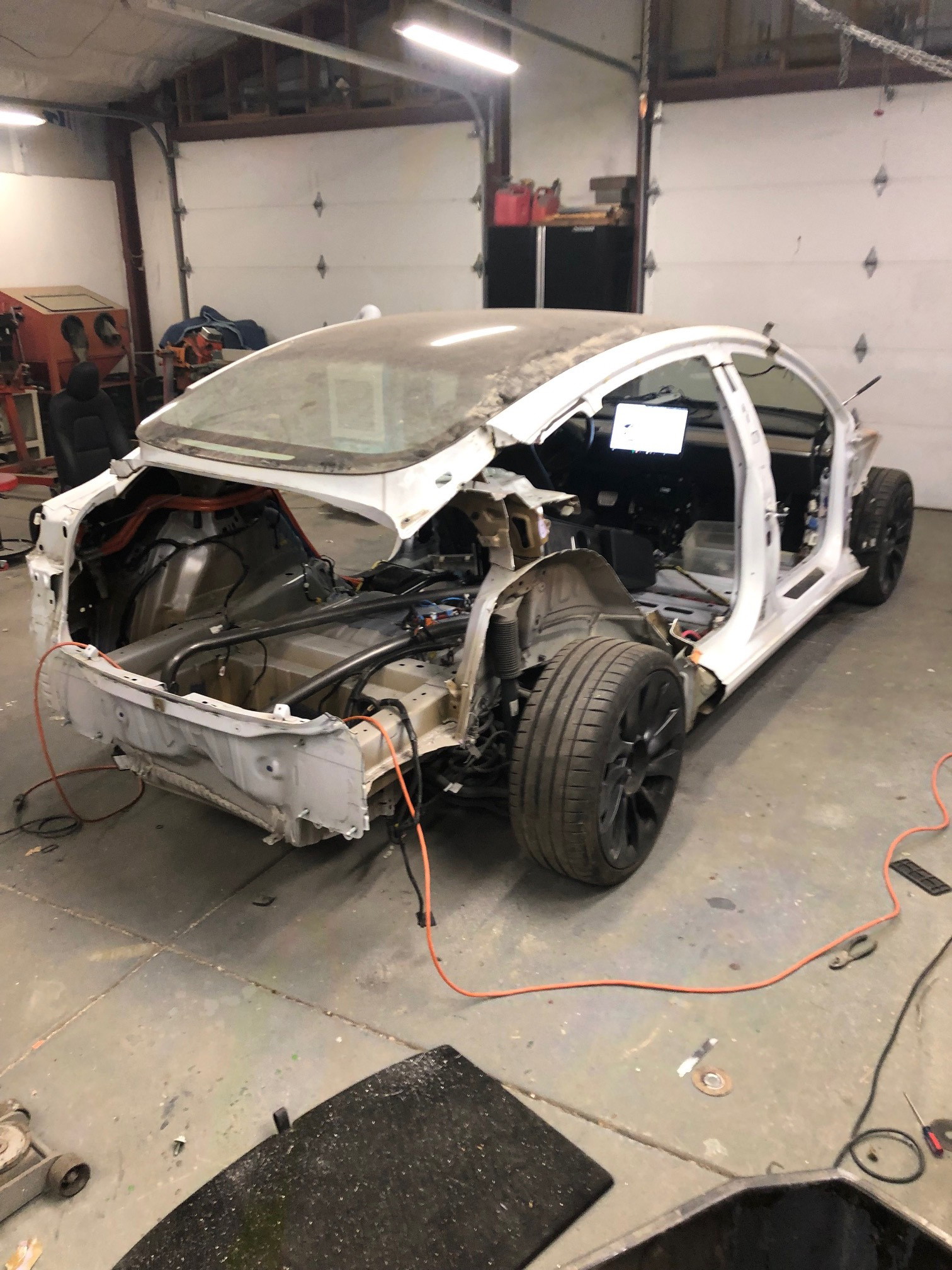
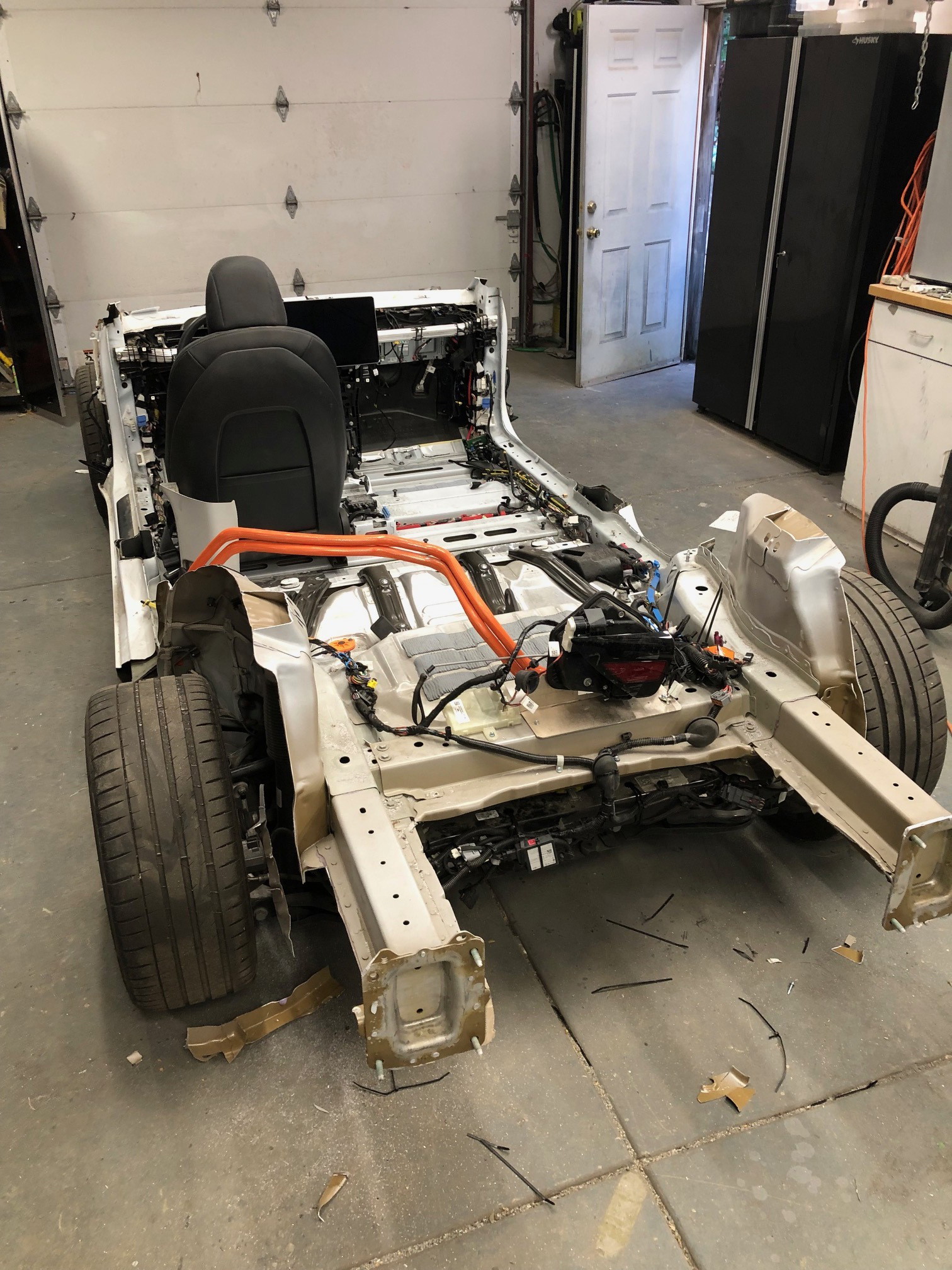
Richardson’s creation was based on Tesla’s Model 3 Performance platform, an all-wheel-drive vehicle that features a small motor at the front and a larger one at the rear. That car costs about $55,000 brand-new but can be found for less than $15,000 at salvage. Since Richardson didn’t need a whole Tesla, a less-than-perfect vehicle with frame, drivetrain, suspension, motors, and battery intact worked just fine.
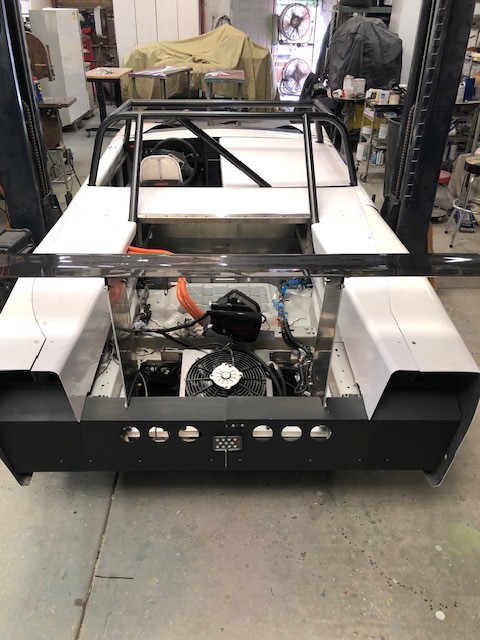
This particular build started by cutting off the body and roof, as well as stripping out all unnecessary parts. A fiberglass Camaro stockcar body was added, as well as all the required safety equipment and competition accoutrements. When all was said and done, Richardson’s Franken-Tesla came in more than 1,000 pounds lighter than stock.
The project included significant modifications that enhanced cooling systems to address heating problems commonly experienced with EV motors and batteries. Added to the front was a second radiator and front motor cooler. A big oil cooler was also added for the rear motor, and front-brake cooling was enhanced with ducts and baffles.
“We actually had the car running pretty damn well where you don’t have to worry about it over heating stuff,” Richardson said. “It’s the fastest car I’ve ever been in, and I’ve had some pretty fast Corvettes.”
The modifications allowed Richardson’s car to last the duration of a 30-minute road race without motors or the battery going into limp mode. Acceleration remained impressive with 0-60 mph attainable in under 3 seconds. A lap around Laguna Seca’s 2.2-mile circuit could be completed in only 95 seconds, and probably less with more testing.
Next Steps
Drawing upon what he has learned, Richardson is preparing for his next build. For starters, he now knows a salvaged Tesla in the United States no longer has Supercharger access at power stations unless the manufacturer conducts battery analysis. With Supercharger permission, the race car can be fully powered up in only 45 minutes. Without Supercharger access, that time is increased to nearly five hours.
This explains why Richardson’s first build is now being used north of the border by fellow EV explorer Jerry Kroll. Regulations are different in Canada, where third-party Supercharging is available to salvaged vehicles. But another recovered Tesla is already on Richardson’s radar, which he’s looking forward to choppin’ up once again. Additional upgrades will be made, a different body style fitted, and a path devised to help others convert Teslas into race cars. The endgame is the creation of an economically viable kit that will be offered commercially to the public.
“Personally, I really do think this is the future,” Richardson stated. “There will always be gas car racing as far as I can tell, but in the future, things will eventually shift to electric cars and I’d rather be doing things for the future rather than the past.”
SCCA Energizes Future by Drawing on Past
Today’s EV exploration is very much akin to the old-school, grassroots development that has powered motorsports and SCCA for 80 years. Guiding current and future exploration is SCCA’s Electrified Vehicle Advisory Committee (EVAC).
EVAC helms creation of unified procedures for EV usage across multiple SCCA disciplines. Be it SCCA Road Racing, Time Trials, Solo®, RallyCross®, HillClimb, or RoadRally, the Committee created a 23-page Supplemental Common Rules for Electrified Vehicles (SCREV) document.
SCREV outlines common safety and training baselines for all EVs across various SCCA programs. It acts as an additional set of rules laying out required elements that ensure the safety of all drivers, volunteers, and track workers when EVs are involved at events.
More about SCREV guidelines can be learned by clicking the link below.
SCREV
Photos courtesy Bruce Richardson
The cobra is a quick, silent snake that strikes fear in the heart of its prey. Much the same can be said of the lookalike Cobra built from scratch in Vancouver, BC, by Doug Yip of SCCA’s Northwest Region. The one-of-a-kind creation is fast, quiet, and ready to attack as a result of being an electric vehicle (EV).
The car has seen action in Regional SCCA® Road Racing, classed as a GT-Overmodified (GT-O) vehicle, as well as HillClimbs where it competes in the Unlimited 1 (U1) field. And if you need proof the vessel is speedy, it recently became the fastest Production-bodied car to ever complete the 2.2-mile Knox Mountain Hill Climb in Canada.
Building a Beast
Perhaps akin to Alessandro Volta’s work more than 200 years ago, Yip is a bit of a pioneer when it comes to electric-powered race cars. This particular project began in 2015 with Yip, a retired mechanical engineer, deploying Solidworks software to design the chassis.
The tubing was CNC cut, then bent fabrication and assembly was done by Kramer Racing, who also supplied the 427 Cobra body mold. Calmar Fiberglass laid the lightweight body, which was modified with flip front and rear sections for easy vehicle maintenance. The suspension utilizes C5 Corvette spindles and hubs, and geometry was computer designed to obtain the exact characteristics desired.
“I actually got together with some of my buddies from engineering school,” Yip said of the brain trust behind this project. “When I told them what I was doing, they all asked how they could get involved. So as far as doing work on the car, we got a whole team.”
The vehicle has gone through multiple modifications, the story of which has been logged at the E Power Racing YouTube page. This Cobra is currently an all-wheel-drive machine propelled by two Tesla Model 3 motors — one for the front wheels and the other for the rears. Each unit can supply upwards of 240 kilowatts of power (roughly 320 hp), and a reconfigured Tesla Model 3 battery pack provides the juice.
“We control the front and rear motors independently,” Yip said. “I ratioed the front motor to give it a little less power and torque than the rear so we don’t get terminal understeer on the car.”
Heat has been a big challenge throughout the project. Most EV motors are “intelligent” and draw back on power as internal temperatures increase. That helps defend against damage, but also greatly hampers performance during a 20-minute sprint race.
“We experimented with all sorts of cooling systems … to keep the motor temperatures down,” Yip said about the struggle. “We decided the only way we could actually keep running through the end of a race was to split the power between two motors. We are now keeping each motor pretty cool by running less power through it.”
“The whole project has been like a big science experiment. We’re always playing, always tinkering,” Yip added. “This was a brand-new learning experience and a lot of fun. When we started, there was actually nobody doing this kind of stuff.”
SCCA Powering Forward
Yip’s creation was constructed to meet regulations set forth by Canada’s Confederation of Autosport Car Clubs. It has since been upgraded to be fully compliant with SCCA’s Supplemental Common Rules for Electrified Vehicles (SCREV).
SCCA’s Electrified Vehicle Advisory Committee (EVAC), of which Yip is a member, is charged with creating unified procedures for EV usage across multiple SCCA disciplines. Be it SCCA Road Racing, Time Trials, Solo®, RallyCross®, or HillClimb, the Committee has been hard at work and recently released the 23-page SCREV document.
The SCREV outlines a common safety and training baseline for all EVs across various SCCA programs. It acts as an additional set of rules laying out the required elements that ensure the safety of all drivers, volunteers, and workers when EVs are involved at events.
To dig deeper into the topic, check out the SCREV guidelines. For even more information, head to the EVAC’s webpage on SCCA.com.
Photo Kyle Thomson
(Jim Rogaski is a member of SCCA’s Electrified Vehicle Advisory Committee, a group tasked with the development and potential implementation of rules based around electric vehicles within the SCCA®.)
There’s one constant in the automotive manufacturing industry, and that is change. We have seen wooden wheels, wire wheels, solid steel wheels, alloy wheels, and carbon fiber wheels. We have gone from mechanical friction brakes to hydraulic drum brakes to hydraulic disc brakes. We have used carburetors and fuel injection, and gone from magnetos to computerized ignitions. We have seen engines that are 1, 2, 3, 4, 5, 6, 8, 10, 12, and 16 cylinders, and let’s not forget zero cylinders with the rotary engine. And now we have electric motors.
The Sports Car Club of America™ has also evolved over its 80-plus year span from a club interested in automobiles to a nationwide organization of motorsport enthusiasts. We are continually adapting the Club to the constant change in the automotive industry, adopting new programs and making adjustments to the rules to address changes in the vehicles we drive daily and in competition. In all of this, electrified vehicles (EVs) have become more and more popular as daily drivers.
EVs are now also being used in several professional racing series. Several of SCCA’s Regions have adopted local Regional-only SCCA Road Racing classes for EVs. SCCA’s National Solo® program has also recognized the need to allow our members to participate in their series by including them in some Street classes as well as developing classes specifically for EVs.
In order to bring consistency to the implementation of rules specific to EVs, the SCCA Board of Directors created the Electrified Vehicle Advisory Committee (EVAC). The EVAC’s mission and goal is to create a centralized set of guidelines and policies that each SCCA program (Solo, Road Racing, Race Experience, RallyCross®, RoadRally, and Time Trials) can draw from their respective programs. The EVAC, working with EV industry professionals, developed the Supplemental Competition Rules for Electrified Vehicles (SCREV). The SCREV is a broad-based document intended to cover all program needs. It is not expected for all programs to fully utilize all the elements it contains. Rather, each program can select the relevant components from the SCREV for their form of competition. To learn more about the SCREV, follow this link.
In addition to creating the SCREV, the EVAC also developed a Frequently Asked Questions (FAQ) document to address common questions about EVs in motorsports. It defines what an EV is and provides recommendations on how to prepare for EV competition at events. It is a helpful guide for competitors, Regions, and venues alike. The FAQ can be found here.
For the SCCA Road Racing program, the SCREV has been working with some of the other Club Racing Advisory Committees to develop EV-specific classes for a Touring-based class and a Prototype-based class.
The Electric Touring Car rules can be found in section 9.1.9.3 of the General Competition Rules (GCR), with the Prototype Electric rules appearing in section 9.1.8.H.
The EVAC recognizes that the documents above are just a starting point for SCCA’s competition programs, and these rules packages will evolve over time as EVs become more plentiful and sophisticated in their design.
If you wish to share your thoughts and ideas with the EVAC, letters and comments can be submitted via this link.
Photo by Andy Shultz
As my final year as Chairman of the SCCA® Board of Directors draws to a close, I’d like to recognize some of the many Club members who helped me during my time as a Director, review the many changes that have taken place over the past six years, and share thoughts on changes yet to come.
Thanks to the members of Area 5/Central Division that elected me to the Board of Directors in 2018. It has been an honor and a privilege to serve you and all SCCA members. Thanks to all the members that have reached out with comments and suggestions during my time on the Board. Although you may not have received the responses that you hoped for, your feedback was heard and considered. For those members who choose to vent their frustrations on social media, I hope you find another activity that brings you joy. Please spend more time on that activity and less pounding the keyboard. We will all be better off.
Thanks to all the volunteers that serve within the Club and make it possible for all of us to have fun with cars. Thanks to SCCA President and CEO Mike Cobb for his leadership and the SCCA National Staff for their dedication and service to the Club. Too often our volunteers and staff don’t receive the credit for the work that they do and are abused on social media for things that are outside of their control.
Many thanks to prior Board Chairmen Lee Hill, John Walsh, and Jerry Wannarka for their valuable advice. I will always be grateful for the perspective you provided on issues that arose during my time as Chairman of the Board of Directors and Chairman of SCCA Ventures. Thanks to all the Directors who have served with me the past six years. Special thanks to the guidance provided by Arnie Coleman and the late Bob Dowie when I first joined the Board. I’m very pleased to see Bob being added to the Hall of Fame. Thanks to KJ Christopher for his long service as Treasurer and insightful comments on financial management and organizational structure. The Club is much stronger today than when you joined the Board. You are directly responsible for that. Thanks to Dayle Frame for founding and leading the Electric Vehicle Advisory Committee (EVAC) along with his work as a liaison to the CRB. You have helped the Club prepare for the future in multiple ways. Last, and definitely not least, thanks to Steve Strickland for his valuable advice and work these past four years as Vice Chairman. I could not have found a better partner in leading the Board.
Changes Lead to Improvements
As for the changes that have taken place during the past six years, a major positive has been the improvement in the Club’s financial position. An important contributor to this was the restructuring of SCCA Pro Racing®, in particular exiting its role as a promoter of events and shifting to a focus on sanctioning and licensing.
Rapid and agile response to the COVID-19 pandemic was also critical. The Board met twice per week during the height of the shutdown to review the ever changing governmental guidelines and revised financial projections prepared by Mike Cobb and staff. Hard decisions were required to keep the Club afloat. Activities were cancelled, often with short notice. Some members of staff were furloughed, others worked for no pay. Without any exaggeration I can say that the work and sacrifice by the staff during this period saved the Club.
Many lessons were learned during the pandemic, and SCCA became more efficient as a result. The Board of Directors meets primarily via Zoom now, with only two in-person meetings per year, saving on travel costs. The virtual SCCA National Convention, begun out of necessity during the pandemic, has proven to have a broader reach and a much lower cost than in-person National Conventions. Some of the cost savings have been reinvested in the Club through support of Divisional Conventions. While membership initially favored a return to the in-person format for the National Convention, a substantial and growing majority now prefer the virtual format.
Another factor contributing to greater efficiency is continuous effort to automate and consolidate functions. The development of the Member Account Portal (MAP) simplified the membership renewal process for both members and staff. Prior to the development of MAP, I received three versions of my membership card each year: One when I renewed my membership, a second when I renewed my competition license, and a third when I signed my annual waiver at the track. Now I take care of all three in one visit to MAP and I receive one membership card. It costs less to generate and ship one card rather than three. Perhaps more important than direct cost savings is that membership and waiver data are now up to date, accurate, and can be easily accessed and searched by staff and volunteers. Building, literally and figuratively, on the success of MAP, staff has spent the past two years building out the ability to register for events. Last year, registration for all Track Night in America® Driven by Tire Rack and Time Trials events was conducted entirely through the SCCA. This insures better compliance with waiver and membership requirements. It also provides greater insight into what types of cars are growing in popularity and what cars are not. This is information that external registration systems, to this point, have been unwilling to share.
The pivot of SportsCar® from print to digital delivery has improved the Club’s efficiency on multiple levels. Eliminating printing and shipping of physical copies saved the Club hundreds of thousands of dollars. These savings have been, and will continue to be, reinvested in the Club, funding a redesign of the SCCA.com website as well as ongoing costs for producing the digital version of SportsCar. In addition to saving money, the shift to digital also results in more timely delivery of information. Rather than waiting weeks after an event to receive printed recaps, stories can often be shared in real time as events are occurring. A number of long-time members had reservations about the elimination of the printed version of SportsCar. It was a difficult decision for the Board. Like all of the Board’s decisions, it had to be made in the best interest of the Club as a whole.
Less visible but equally important, the Club’s efficiency has been and continues to be improved through changes in organizational structure and governance documents. During 2020, the Bylaws of SCCA Ventures were amended to provide the SCCA President direct authority and responsibility for SCCA’s for-profit subsidiaries: SCCA Pro Racing and SCCA Enterprises.
More recently, the Board of Directors revised the SCCA Operations Manual to require that each program board include a National Staff member to ensure greater awareness and cooperation on meeting the needs of each program. A similar effort is currently under way for the SCCA Foundation. In this case, the Foundation Bylaws are being amended to require that SCCA Board liaisons to the Foundation be full voting members of the Foundation Board. The intent is to ensure greater awareness and coordination on Foundation activities. To improve the functioning of the SCCA Board, the Governance Committee recently completed a comprehensive update of the Directors Handbook. The Executive Committee updates and delivers an orientation presentation to new Directors each year. Central to the orientation is the message that Directors must act in the best interest of the entire Club rather than any particular group of members.
The Club has made great strides in communicating with members. SportsCar News provides weekly updates on SCCA activities via email. The marketing staff generates content that is shared on several social media platforms. Mike Cobb delivers a quarterly update presentation to the full membership. He and members of the National Staff also hold quarterly interactive Zoom meetings with Region leaders. With assistance from staff, the Board of Directors has worked to educate the membership on the Board’s role and how to become a Director. These topics have been addressed in sessions at the SCCA National Convention as well as articles on the SCCA.com website.
The Club has also made great strides in fostering a welcoming environment for members and guests. A welcoming environment statement and code of conduct were added to SCCA’s Operations Manual in 2019. Video presentations and FAQ documents detailing acceptable and unacceptable behaviors are available on SCCA.com along with a hotline number and a complaint form to report questionable behavior. Each report is investigated by SCCA staff. Most result in the counseling of individuals by staff to adjust behavior. Some are advanced to the Board of Directors with recommendations for action ranging from suspension of membership to expulsion from the Club.
The Steps That Come Next
Where do we go from here?
Information technology will continue to be a high priority. The Board has authorized the hiring of an Information Technology Director who will supervise efforts to rebuild SCCA.com with enhanced capabilities. The IT Director will also work to expand existing automation of tasks and data collection, with a priority on event registration.
The restructuring of the SCCA Road Racing program will continue with further consolidation of National Championship Runoffs® classes to occur in 2026. Additional classes may lose their Runoffs eligibility. Classes that have lost their Runoffs eligibility may return if they succeed in increasing participation at U.S. Majors Tour® events. New unforeseen challenges will certainly appear.
I am confident that the SCCA Board of Directors, led by its new Chairman Bob Crawford, is ready for whatever lies ahead. As for me, I will be taking an advisory role within SCCA Ventures and spending a lot more time racing my Spec Racer® Fords.
See you at the track!
SCCA’s Electrified Vehicle Advisory Committee (EVAC) has released proposed guidelines and rulesets for EVs and three EV racing classes. These documents are available for review right now, and the EVAC is seeking feedback.
SCCA Area 4 Director Dayle Frame, who leads the currently 12-person EVAC team, said the three documents contain general guidelines for EV usage at all SCCA events, as well as rulesets for development of an “E” Touring category of road racing cars and a Prototype category electrified vehicle class within SCCA Road Racing.
“None of these proposed rulesets have actually been OK’d yet by the Club Racing Board or SCCA Board of Directors,” Frame noted. “But we’re making these rule suggestions available now because we want input to properly assess where the SCCA membership wants to go as far as EVs are concerned.”
The EVAC’s proposed guidelines can be reviewed in full by clicking the link buttons below. Member feedback can be submitted via the online form found at crbscca.com, selecting the “Electric Vehicle” category after clicking “Club Racing Board” as the letter type.
SCREV Electric Touring Prototype Electric
A Closer Look
Be it Solo, Time Trials, SCCA Road Racing, RallyCross, HillClimb, or RoadRally, the 23-page Supplemental Common Rules for Electrified Vehicles (SCREV) looks to provide sage guidance for not only drivers and teams, but also event organizers and volunteers. The SCREV outlines a common safety and training baseline for all EVs across the various SCCA programs. It acts as an additional set of rules laying out the required elements that ensure the safety of all drivers, volunteers, and track workers when electrified vehicles are involved at events.
Within the SCREV text, it is noted that interpreting these supplemental competition rules for EVs shall be logical, as the document cannot cover all possible situations. As EV technology and safety guidance evolve, the SCREV will also evolve to support SCCA and its members.
When it comes to the new “E” Touring category of road race cars, the purpose and philosophy behind this development is to allow SCCA members the opportunity to compete in battery electric vehicles (BEVs) with limited modification that are suitable for Club sprint races. Modification to vehicles competing in the “E” category, including safety-related modifications, are limited only to those specifically allowed within the proposed ruleset.
Only cars available to the general public for purchase, and listed on manufacturer spec lines, will be eligible to compete within the category. Such vehicles must be approved by the Environmental Protection Agency and Department of Transportation for sale in the United States, or by Environment Canada for sale in Canada. However, it is important to note that car prep to meet category competition will result in the vehicle becoming a dedicated electric race vehicle, making it non-street legal.
The other document available for review deals with the new EV Prototype class. This ruleset encompasses converted, existing race cars, and new purpose-designed vehicles built using electric vehicle power technology that fit within the proposed rules.
Some technologies have been prohibited in the Prototype-based EV class due to cost, safety, availability, and complexity. As the individual status of prohibited technologies changes, they may be approved to aid in keeping the class current and attractive. These rules are not intended to freeze the class in time, but rather to encourage orderly and progressive change to keep the class current.
A rules package for EV formula cars is currently in the works.
Leading the Way
While internal combustion engines are not leaving SCCA competition anytime soon, EVs are very much the next major evolution in automobiles. In fact, several major auto manufacturers have committed to ending production of combustion engine vehicles within the next 15 years. Mike Cobb, SCCA President and CEO, certainly understands the passion nearly all SCCA members have for the combustion engine, but also knows the importance of looking to the future.
“For more than 75 years, Sports Car Club of America has spearheaded evolution in motorsports,” Cobb said. “SCCA has been the leader when it comes to engineering developments, safety improvements, and establishing standards that fuel a safe, fun, and exciting motorsports experience.
“Our Club is uniquely positioned to again define the future of racing across the United States, and perhaps the world, thanks to the unequalled expertise of our membership,” Cobb added. “By embracing developing technology around EVs, SCCA will again be a leader in motorsports for another 75 years and beyond.”
Frame noted that the EVAC — comprised of representatives from SCCA Road Racing, Track/Time Trials, Rally/Solo, and EV industry experts — has only begun its work. EVs have already won major events in SCCA Solo and Time Trials, meaning the motorsport landscape is already changing with great speed. So, the EVAC must remain focused on its task and be aware of the rapid pace of development.
“To say the future is ‘now’ would be an understatement,” Frame noted. “The work we, as a Club, put into EV matters today will help ensure a quality experience for SCCA members and motorsport enthusiasts for many years to come.
“There will be growing pains, and some decisions will need to be made quickly at times. That is just fact due to the lightning speed at which this technology is evolving,” Frame continued. “We ask SCCA members to be patient, understanding, and supportive as we all learn how best to utilize EVs for our sport and passion. But the EVAC will remain diligent to its task, and we promise to keep members aware of the path we’re headed.”
This is an important time in motorsports and SCCA’s history.
Please take time to review the three documents prepared by the EVAC, and don’t be shy to submit feedback at crbscca.com.
To show commitment to electric and hybrid vehicles and the enthusiasts who drive them, the SCCA has formed the Electrified Vehicle Advisory Committee (EVAC) to create unified procedures across SCCA programs for Electrified Vehicles (EV).
EVs have won major events in SCCA Solo and Time Trials, and major manufacturers have committed to only electric in the future which has created a need for regions and motorsports circuits to have the capacity for the flow of interest EVs are generating. The 9-person committee is being led by SCCA Area 4 Director Dayle Frame–EV owner and Solo competitor–and made up of representatives from Road Racing, Track/Time Trials, Rally/Solo and industry experts. The first tasks the EVAC has been charged with are to create basic safety rules for EVs at SCCA events and to help guide regions and facilities when it comes to training and being equipped for EVs.
“In my duties as an SCCA Director I saw a need for the SCCA to have a long-term plan for incorporating EVs and their powertrains into all levels of participation,” said Frame, who researched how each individual SCCA program was approaching EV participation and formed the committee based on those procedures and needs. “Because EVs were not something that many in the SCCA have experience with, we knew that we needed to form a committee with a broad range of experience, and we’re looking forward to what we can accomplish and enabling more EV’s on the grid.”
While the focus is currently on the foundational elements of EV participation, future goals of the EVAC include procedures for technical inspections of non-production EVs and the potential for rulesets for EV specific competition classing.
As with any SCCA program, the EVAC welcomes your feedback. You can share your thoughts by sending a letter to the Club Racing Board under the Electric Vehicle Category.
Want to stay up to date on our work with Electric Vehicles?
LET US KNOW!