


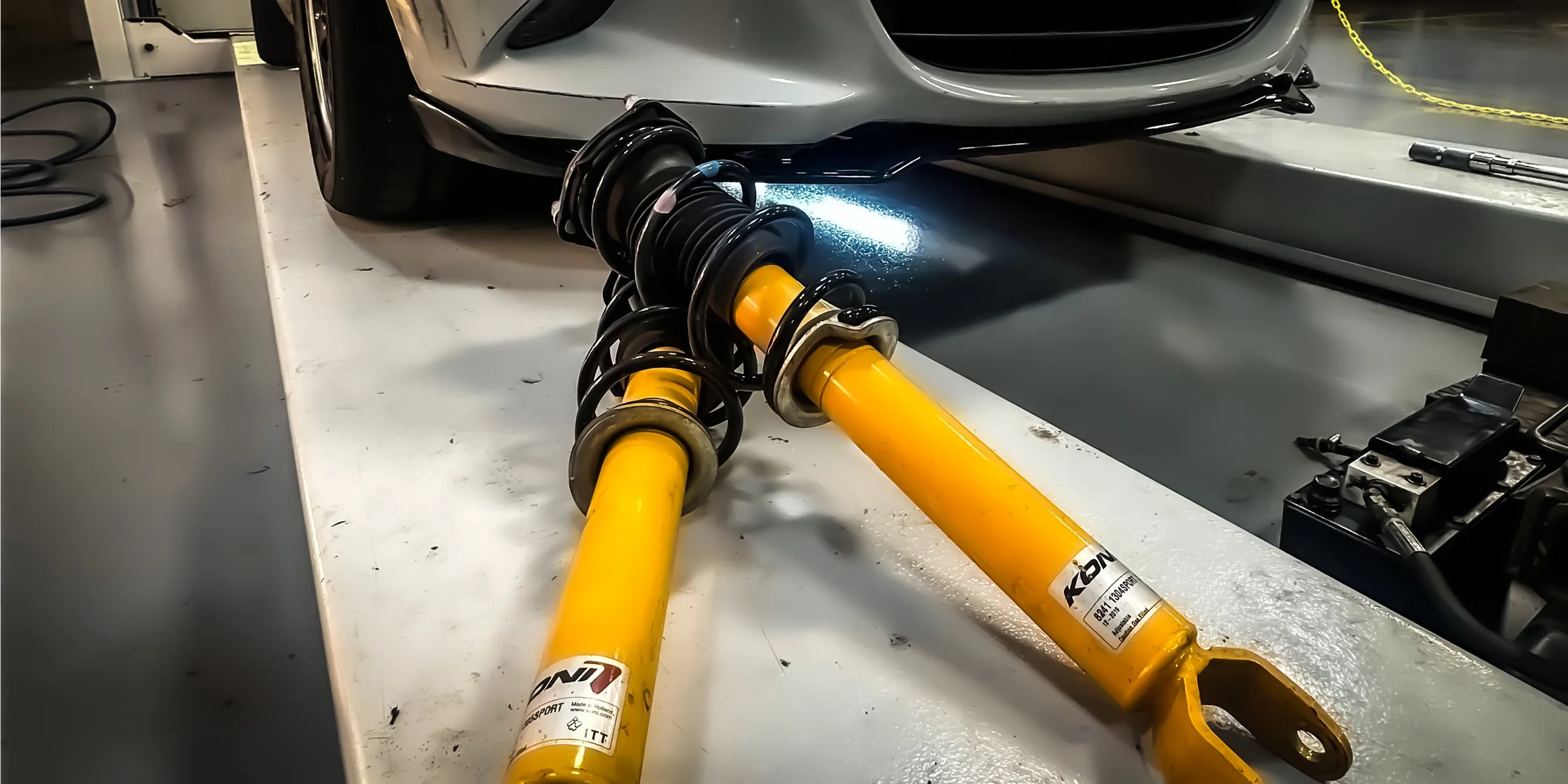
You’ve purchased new dampers, pulled them out of the packaging (where they may have been compressed for shipping), and the damper shaft doesn’t automatically extend by itself. Your first thought: Is the damper blown? Unless the shock is actively leaking, there’s no need to panic, because the short answer is no, it’s fine. Whether or not a damper self-extends when not installed on a vehicle is more a side-effect of the presence of an internal nitrogen gas charge than it is an indicator of proper or improper damper function.
From monotube to twin-tube, SCCA® partner KONI makes a variety of shocks, some of which may or may not self-extend when new based upon their internal design and the presence (or lack thereof) of a nitrogen gas pressure charge inside. “KONI makes three different types of shock absorbers,” Mason O’Hara, Technical Sales Representative for KONI, explains in one of the company’s FAQ videos. “We make a [twin-tube] hydraulic [design] which carries no gas charge, a twin-tube, low-pressure nitrogen gas charged [design], and also monotube high-pressure gas [design] shocks.”
This all depends which damper design was chosen to bring out the best ride and handling characteristics for that particular vehicle.
According to O’Hara, a shock that has an internal gas charge will likely self-extend, although it won’t be quick. “It could take five seconds. Could take 10 seconds. [It] depends on a number of [variables like] if it’s an adjustable shock, where it’s adjusted, internal guide seal friction [if new],” he says, adding, “[Very slight friction or] drag on the piston rod can change the rate at which the piston rod self-extends.”
Hydraulic shocks, meanwhile, have no gas charge, so those shocks will not self-extend at all. They will simply stay in the same position unless moved by another force like a vehicle’s suspension in motion or by being pulled or compressed by hand.
“So yes, some shocks will extend on their own, some will not — [it] depends on the type and the design of the shock absorber itself, and whether or not it carries [an internal] gas charge,” he says. “But even if it does carry a gas charge, the rate of extension itself can still change.”
Although it may seem like noting the rate or lack of self-extension is evidence of a potential issue, it alone does not.
Armed with this knowledge, give your new dampers a good once-over for damage that may have occurred in shipping, then if all looks fine, install them, find an SCCA event near you, and go have #funwithcars.