

This article originally appeared in Pit Talk, the official publication of New England Region, SCCA Inc. It is published online and available in print free of charge to all members of the Region. View more great Pit Talk content here.
When it comes to getting out on a road course, SCCA offers three ways car enthusiasts can experience the fun of driving on a dedicated race track. From the entry level Track Night in America series of events, to Time Trials competitions, and the most recent Club Racing Experience that prepares drivers for full wheel-to-wheel racing action, there are plenty of opportunities and ways to get out and have #funwithcars.
However, for those new to SCCA and motorsports, understanding the differences between each of these events may be difficult. So we’re here to break it down and make it simple. Two easy to understand charts that quickly answer the questions about what’s similar and what’s different.
Breakdown the Similarities and Differences
The one thing all three events have in common is that they are held on dedicated road racing courses. Unlike Rally events that are on rally tracks (dirt and gravel courses) or Autocross events that are typically held on parking lots or airport tarmacs; CRE, Time Trials, and TNiA are all scheduled at tracks like Thompson Speedway, Lime Rock Park, or Palmer Motorsports Park.
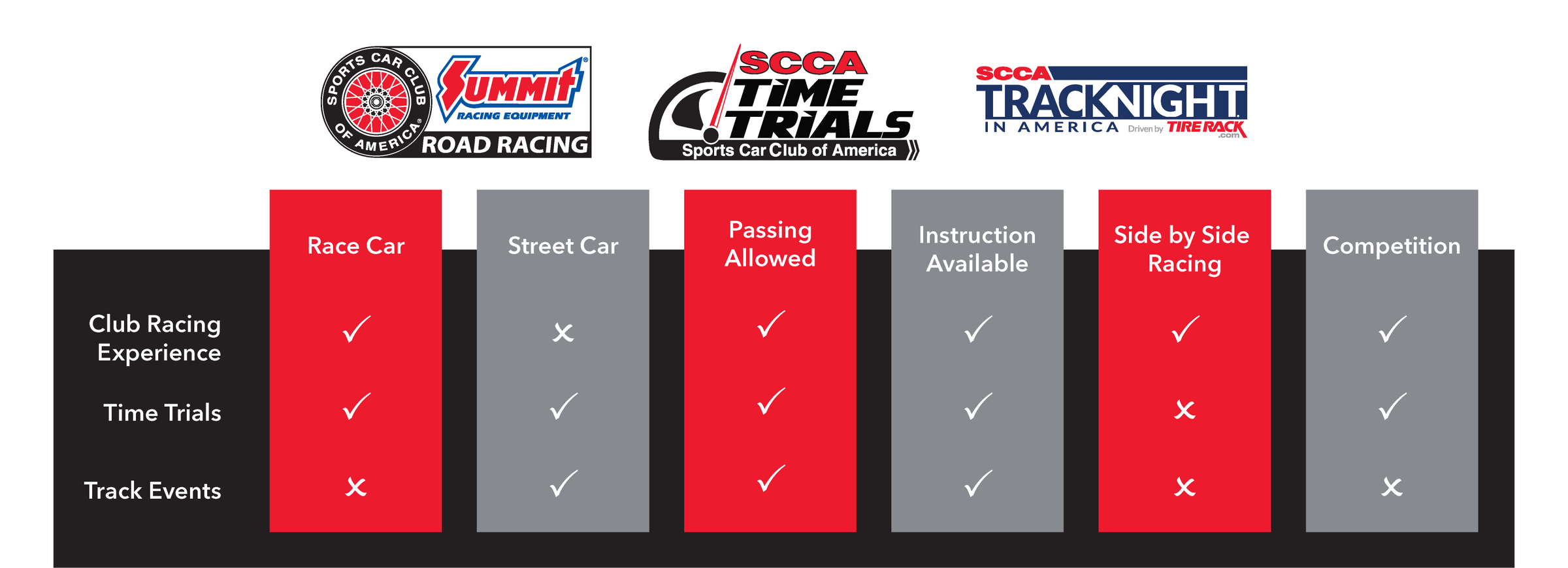
Beyond that, some aspects of each event may crossover across multiple formats, and others might be completely unique to that one specific event. In this chart, we look at:
- Type of Car: Race car — a prepared, purpose-built racecar with a full cage, safety gear, and performance racing parts; or Street car — a licensed and registered vehicle for daily driving on local roads.
- Passing: Can drivers overtake and pass cars while driving around the course?
- Instruction: Are there experienced instructors guiding and advising participants?
- Risk: Are cars kept separated with enough distance between them that contact between each other is minimal and easily avoided?
- Competition: Do we collect times and list winners at the end?
Understanding the Differences
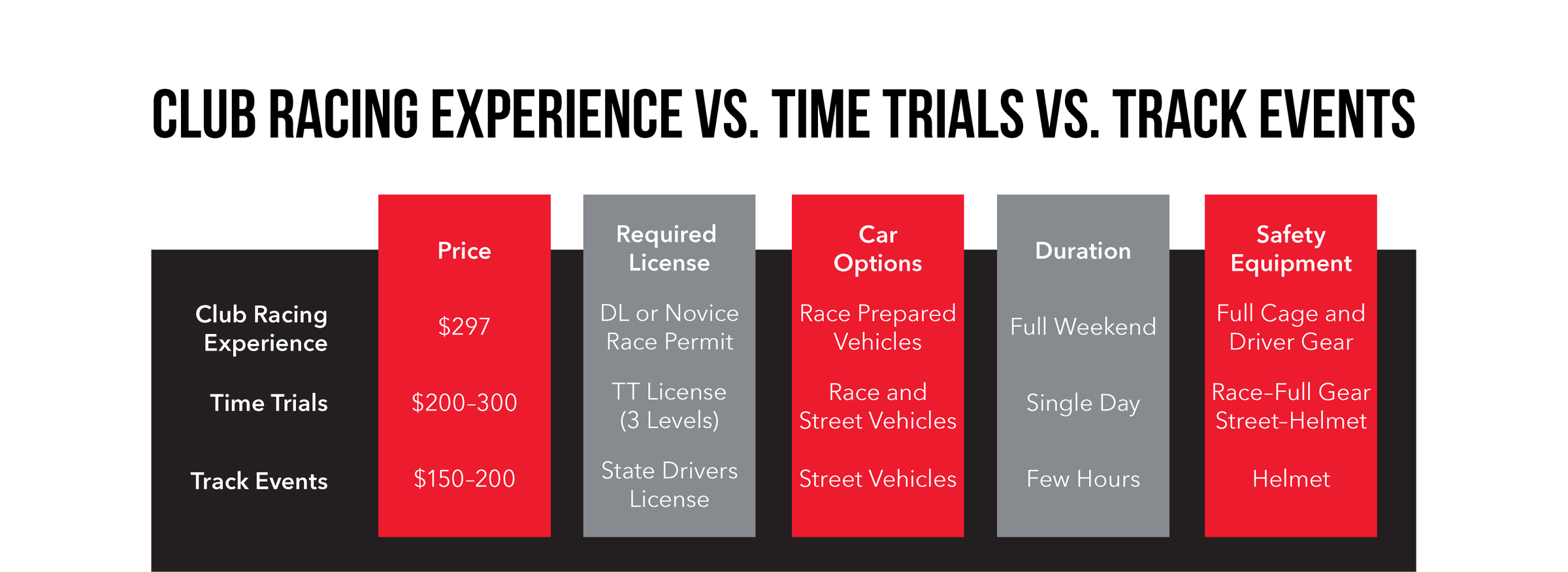
The last comparison touches on costs, time, and equipment needs to participate.
- Cost: Typical entry fee. This does not include costs for fuel, food, or other sundry items used during the event.
- License: In order to participate, what licensing requirements must a driver obtain in advance?
- Car Options: Race vehicles, street vehicles or both.
- Time: Do you need to set aside an entire weekend, or just a couple hours?
- Safety Gear: What’s required to participate safely during the event?
Words by Melissa Introne