


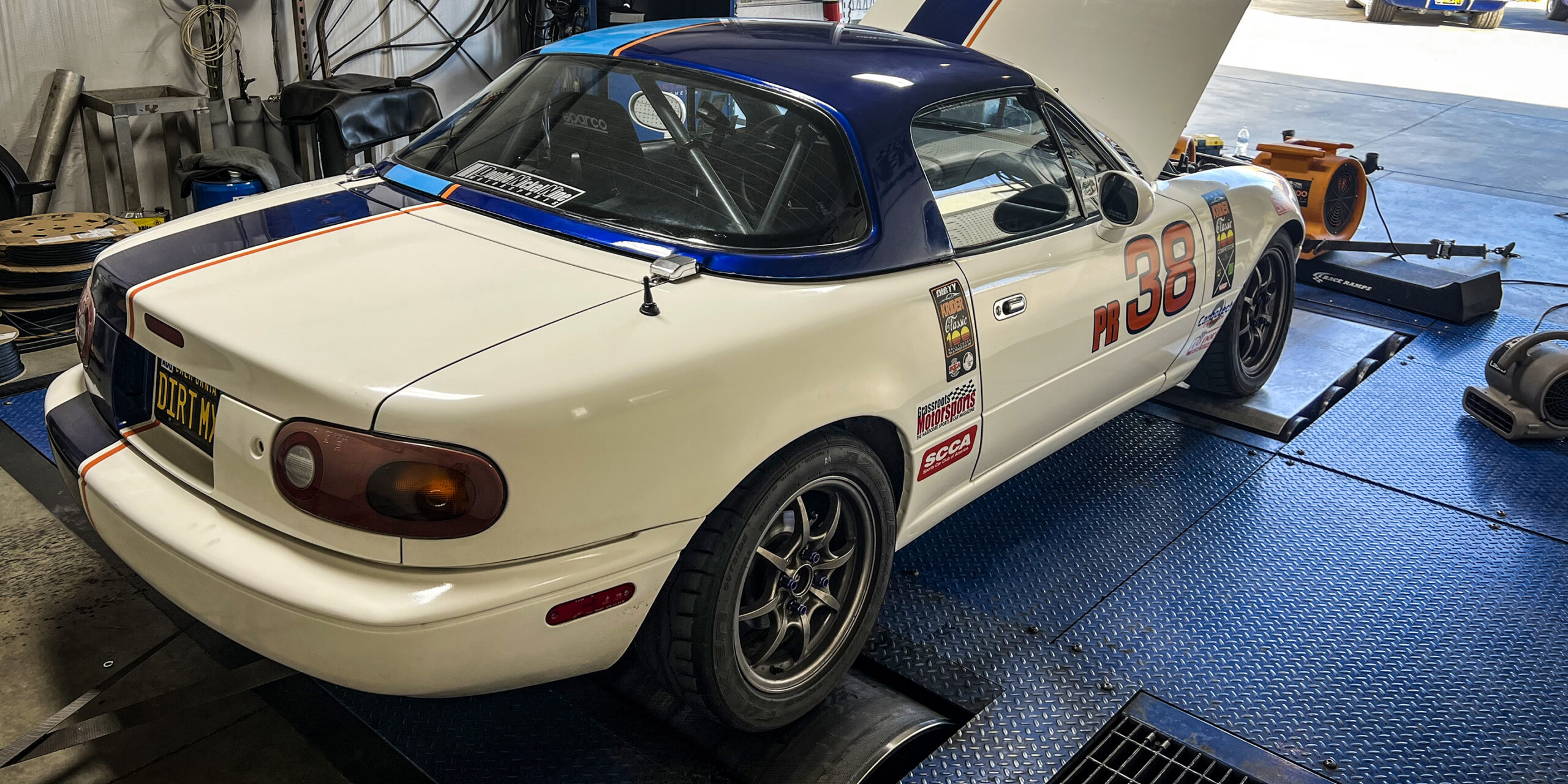
If you hang around cars long enough, the subject of horsepower is bound to come up. At every Cars and Coffee event in America, you’ll find a couple of dudes standing beside their favorite rides, sipping lattes and debating which car has the most horsepower. These discussions are usually based on the numbers published by the manufacturer, which reflect horsepower at the crank, not at the drive wheels, where it really counts.
SCCA® members who actually compete in their vehicles have a much better understanding of horsepower and, more importantly, torque (the number that really matters on track). Racers don’t spend much time debating horsepower claims online. Instead, they take their cars to a shop and put them on a chassis dyno.
A chassis dyno measures horsepower and torque, and the goal is to find ways to improve performance. If you can make your engine more efficient, help it breathe better and get the tune right, you’ll be rewarded with more horsepower and torque (and faster lap times). But dyno time can be expensive, with most shops charging by the hour, so your time on the machine is limited.
Having a plan for how to use that precious dyno time wisely will greatly improve your chances of leaving with a faster car, not just less money in your wallet. To help with that, here are five things you need to know before your next dyno day.
Have the Right Tools
The staff will strap your car onto the dyno, run it a few times, and give you a printout of the results. If you want to make changes to improve those numbers, changes will need to be made to the car. Unless the tuner is making those adjustments for you, you’ll need to be prepared to make them yourself.
Speaking of that printout, here’s a little heads-up: You probably won’t like the results. Real-world dyno numbers depend on the machine itself, measurements at the drive wheels, the weather, the shop’s elevation above sea level, and a multitude of other factors that can affect horsepower readings. Those numbers will be lower than what your favorite YouTube car reviewer said your car makes. Don’t be discouraged. You’re not at the dyno to get a report card with a big number. You’re there to improve whatever the starting number happens to be.
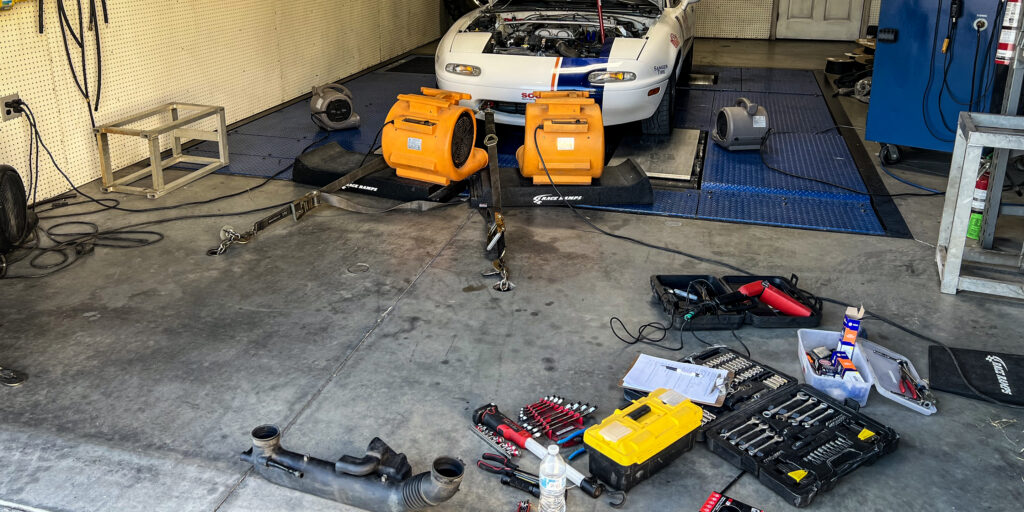
Bringing the exact tools you need to adjust fuel pressure, check timing, swap spark plugs and change an intake tube or air filter will help your day go smoothly.
To improve your numbers, you need to be able to make adjustments. Depending on the car, that could involve adjusting fuel pressure and timing, flashing the ECU, trying a different air filter or muffler, or bolting on a different intake tube. To accomplish any of this, bring the exact tools required to make those changes.
During your dyno day, you’ll probably be at a race shop. If you ask the mechanic in the bay next to the dyno if you can borrow some tools from his Snap-on toolbox, you’ll quickly discover that guys who make a living with their expensive tools don’t like to share them. Save yourself the awkward moment and bring what you need.
Also, if you’re going to adjust the timing, make sure you know how to do it. Check that you have clear, easy-to-read timing marks on the engine. Dyno time goes by quickly, and the meter is always running. Be proficient at making these mechanical adjustments, and make sure you have the necessary tools before you arrive.
Personally, I like to use my own timing light because I know it’ll be the same one I’ll use at the track after replacing a head gasket. That way, I’ll have confidence setting the timing to the best horsepower number I found on the dyno, using the same timing light at the track.
Bring a Ready-to-Run Vehicle
The dyno is the place to improve performance, not get a car running. I’ve seen people show up at shops with a check engine light on. That’s a big mistake.
Modern cars have many sensors, and when the ECU detects a bad sensor, it often rolls back engine performance while allowing the car to keep running. You won’t have a successful day trying to improve performance if the ECU has already locked things down.
Additionally, just because you’ve parked your car on a shop’s dyno doesn’t mean the staff will diagnose all your car’s problems and fix them before your first pull. If you want the shop to fix the car, you’ll need to schedule that work separately and beforehand.
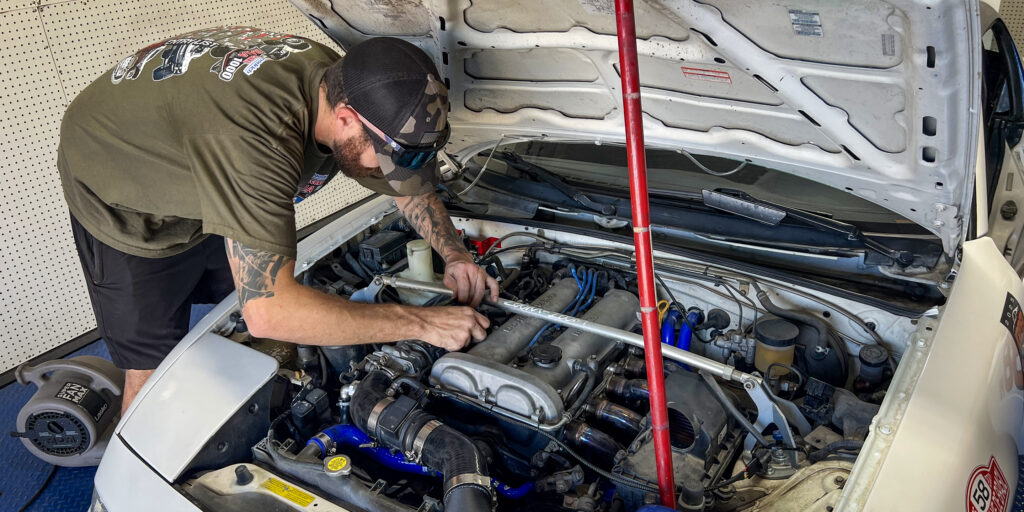
Here, Nathan Brasil at Caliber Customs is fixing my Miata, not tuning it. Had I brought the car in better condition, we would’ve spent more time tuning and less time saying, “Let’s get this Miata to run correctly.
Make sure your car has the correct amount of oil. You’ll be making multiple pulls at high RPMs, and you want to ensure the engine’s oil pump is getting what it needs. Also, make sure there’s fuel in the tank (and that it’s the same fuel you use when racing). Running out of gas on the dyno happens more often than you’d think, and it brings all progress to a halt.
The entire car needs to work, including the transmission. For your pulls, you’ll be running in the gear closest to direct drive.
If valve adjustments are a thing for your car, do that before you go. Valve adjustments need to be made with a cold engine block. Once you start making dyno pulls and everything heats up, you won’t be able to make accurate valve adjustments.
Have a Bung in Your Exhaust for an O2 Sensor
To get your combustion engine running at peak performance, the air/fuel ratio needs to be right (usually around 12.5 to 13.0 at wide-open throttle). The only way to verify that number is with an oxygen sensor (O2 sensor) that the dyno can read.
The sensor’s location is crucial. It should be installed between the header and the catalytic converter (if you have one). Placing a sensor at the exhaust tips, behind the mufflers at the rear of the car, isn’t optimal.
Tuning a car without knowing the air/fuel mixture is actually dangerous. You can permanently damage your engine. You didn’t pay to spend time on the dyno to break stuff. – you paid to make things faster.
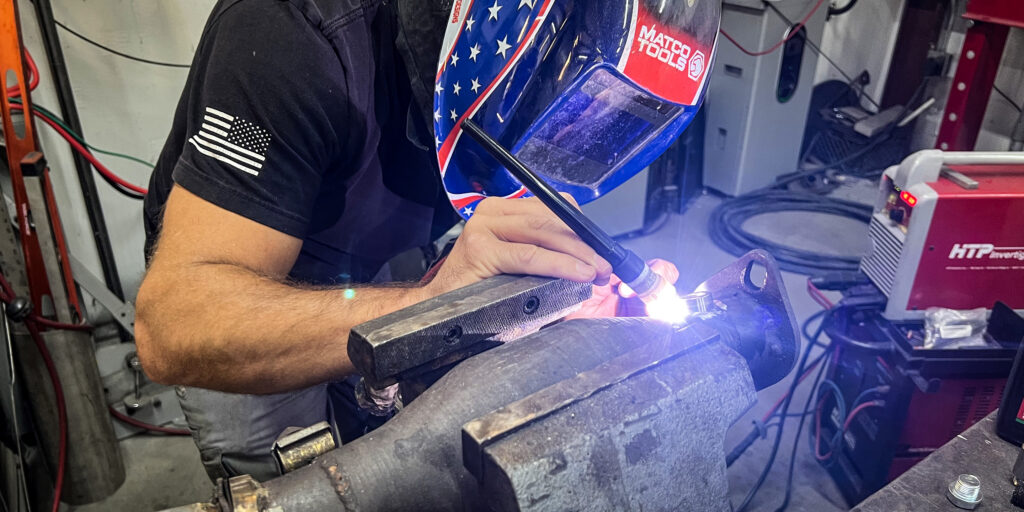
Matt Lembrecht, owner of Caliber Customs in Madera, CA, uses his fabrication skills to weld an O2 sensor bung into my Miata’s exhaust. I should’ve had this done before I showed up.
The key to making this work is having a spot in your exhaust, called a bung, where the dyno’s O2 sensor can be installed. The standard thread size for an exhaust oxygen sensor bung used with a chassis dyno’s wideband air/fuel ratio sensor is M18 x 1.5 mm.
Some aftermarket headers already have a bung, while others don’t. Figure out what your car has and take the time to get one installed before heading to the dyno. Or be dumb like me, and spend expensive dyno time welding a bung into your exhaust instead of tuning your car for better performance.
Check Your Tires and Tire Pressure
When you head to a chassis dyno, your brain is focused on the engine, which means you might be ignoring the tires. Don’t ignore your tires.
The drive wheels will be spinning on the dyno drum at speeds exceeding 100 mph. Dyno shops know this, and if they see cracks in your tire sidewalls or really old tires on your car, they may not let you make any pulls. That’s for their safety and yours.
Make sure your car has good tires, preferably with a date code less than five years old. If you’re unsure how old your tires are, check out this previous article, 5 Things to Know About Tires.
You also need to make sure your tire pressure is correct. Tire pressure can affect your horsepower numbers. The goal is to make safe, successful pulls while testing adjustments that improve performance. Having good tires at the right pressure is essential.
Have a Systematic Approach
OK, you’re on the dyno. You’ve got your tools ready, your car is running well, the O2 sensor is measuring the air/fuel ratio (AFR), and you’ve got good tires on the car. Now what?
It’s time to put your plan into action and get the most gains possible while you’re on the dyno.
I like to use a checklist and follow a specific order of operations. First, if the AFR isn’t in the correct 12.5 to 13.0 range, I’ll adjust the fuel pressure to get it there. Once that’s correct and I’ve made a few more pulls, I’ll see if advancing the timing helps improve engine performance.
Fuel pressure and timing are the two things many Miata racers work with. Once I’ve got those two things set, I call them my baseline settings and write them down: “Fuel Pressure: 43 psi. Timing: 13 degrees advanced of Top Dead Center (TDC).”
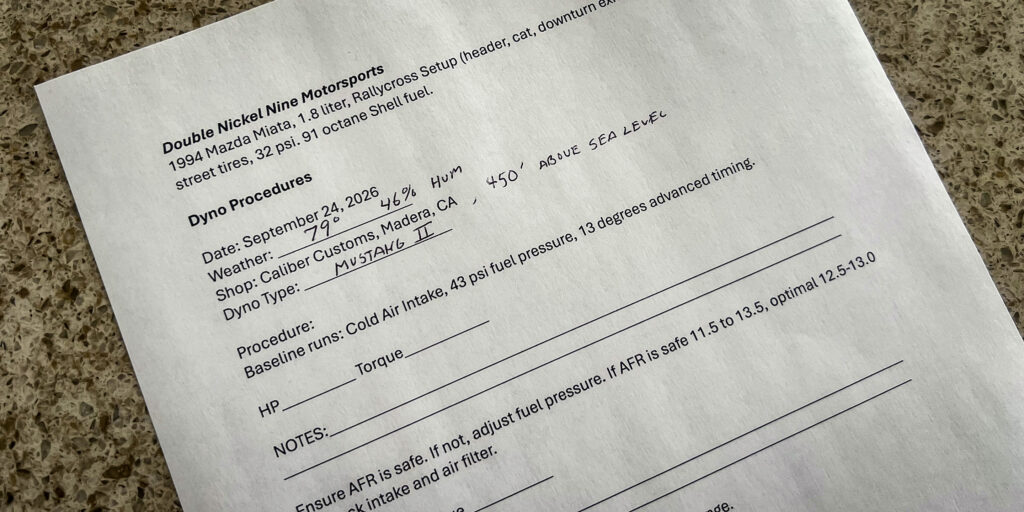
Part of a systematic approach is using a checklist, having a plan in place and executing it one step at a time. Write down your baseline settings so you can always go back to them.
Once you’ve exhausted the possibilities for improving horsepower and torque, it’s time to move on to other things you might want to try. A different muffler? Bring gloves, because your exhaust is going to be hot. A different drop-in air filter? A different intake tube? Colder ignition plugs?
You’ll need to have these items with you, along with the tools and know-how to swap them out quickly before the next pull.
Remember to make only one change at a time. That reminds me of another article that can help you here: Tuning Tips: Change One Thing at a Time.
If you’re going to reflash an ECU, understand that the process can take time. Make sure you’ve got enough time to complete it before your next dyno pull. Remember, the meter is running – you’re probably being charged by the hour.
Using a systematic approach and writing down all your dyno results on a checklist is extremely helpful. What was the change? New air filter. What was the result? Plus 2 hp, minus 1 lb-ft of torque.
When you write down the changes and results, you can quickly identify what worked and what didn’t. The dyno will show you graphs of your horsepower and torque curves, but after a day on the dyno and 15 different pulls, all those graphs start to blur together. Unless the technician is making notes on each pull, you might not know which graph represents which change.
Don’t rely on the shop tech to keep track of the changes you’re making. Instead, take good notes yourself so that when you leave, you know what worked and what didn’t.
When you look at your dyno results, the horsepower and torque curves will show you whether your changes are moving you in the right direction. However, the reality is that not all changes are good. Sometimes an adjustment actually makes things worse. If that happens, go back to your baseline settings and try something else.
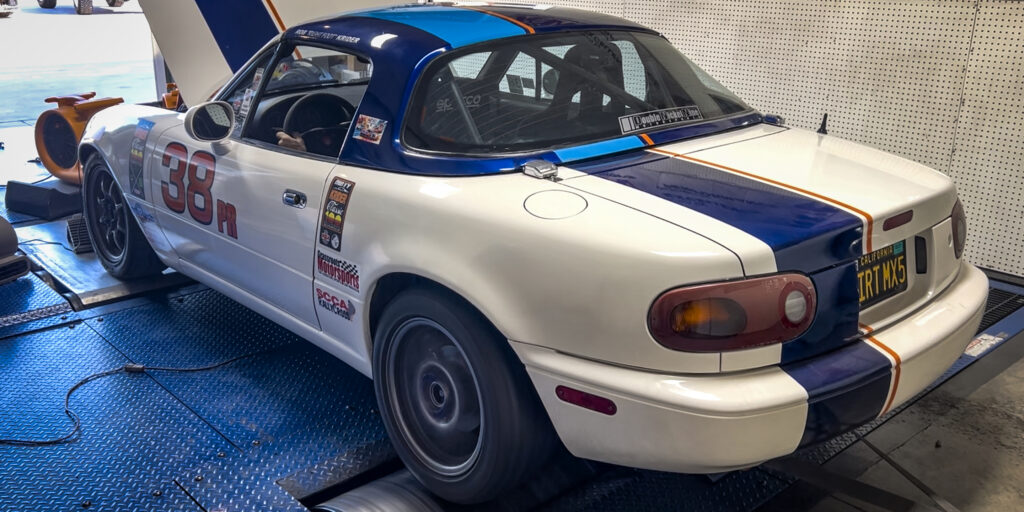
The goal is improvement. If you leave the dyno with more horsepower and torque than you had when you arrived, you’ve had a good day.
Seeing those numbers go up and improving performance is what we all want when spending a day (and a few hard-earned bucks) at the dyno shop. These five tips will certainly help point you in the right direction (up, up, up).
And remember, racers don’t really care about horsepower. Racers want torque!
(About the author: Rob Krider is a national champion racer, the author of the novel Cadet Blues, and the host of the Stories and Cocktails podcast.)
Photos by Rob Krider