There were 23 races during the Oct. 3-4 Hagerty Race Days at the 2026 Mission Foods SCCA® National Championship Runoffs®, and within each one, a driver was awarded the Sunoco Hard Charger award for picking up the most spots during the race. But while every Sunoco Hard Charger is worth celebrating (and we’ll do that below), there were certainly a few that took charging through the field to a whole new level.
If there were a Sunoco Hard Charger of Sunoco Hard Chargers, that award would go to Milwaukee Region’s Cam Ebben. Racing in Spec MX-5, Ebben would probably take the award for the ages, too, as he started the 13-lap race in a spec class in 22nd position, and by the checker he was leading the field, claiming the win for his second Runoffs gold medal in the class.
Picking up the same number of positions was Central Florida Region’s Brian Schofield in Spec Racer® Ford Gen 3. Qualifying 23rd, Schofield ran through the pack to finish a close second.
Other Sunoco Hard Chargers finishing on the podium include Paul Schneider from Central Carolinas Region who started fifth and finished second in Formula Enterprises® 2, as well as Florida Region’s Matt Strand, who took third in Prototype 2 after starting ninth, and Michael Kamalian from Atlanta Region who started fourth in American Sedan® and finished third.
Two Milwaukee Region members had a unique occurrence in their earning the Sunoco Hard Charger award. Steve Sargis earned the award in H Production, starting 11th and finishing third, while his son Mark took the award in F Production by starting 26th and finishing sixth.
Speaking of Milwaukee Region, if there were an award for the most Sunoco Hard Chargers from a specific Region, it would go to Milwaukee this year, with four. While Blackhawk Valley Region earned three, honorable mention would certainly go to Puerto Rico Region, with two of that Region’s drivers picking up the award, matching the two Sunoco Hard Chargers from Florida Region. Add in the one Sunoco Hard Charger from Central Florida Region, and you begin to think there must be something about America’s southeast corner.
And we’d be remiss if we did not also mention the Sunoco Hard Charger in Formula 600. Glen Thielke (one of those four Milwaukee Region members) started 13th and finished ninth in the class. Why is that significant? Because Thielke is a past SCCA Worker of the Year and John McGill Award winner.
Below is a listing of all of the Sunoco Hard Charger winners from the 2026 Mission Foods SCCA National Championship Runoffs. Note that in some cases, certain drivers may have increased their positions more but due to penalties assessed in qualifying, they did not qualify as the Sunoco Hard Charger.
2026 Sunoco Hard Chargers
Listed by class: driver; Region of record; car; starting position, and finishing position.
American Sedan®: Michael Kamalian; Atlanta Region; Ford Mustang GT; Started 4th, finished 3rd
B-Spec: Kent Carter; Houston Region; Mazda 2; Started 14th, finished 8th
E Production: Don Tucker; Mid South Region; BMW Z3; Started 14th, finished 8th
F Production: Mark Sargis; Blackhawk Valley Region; Mazda Miata; Started 26th, finished 6th
H Production: Steve Sargis; Blackhawk Valley Region; Triumph Spitfire; Started 11th, finished 3rd
Formula 600: Glen Thielke; Milwaukee Region; Red Devil Rotax; Started 13th, finished 9th
Formula Atlantic®: John Norton; Arizona Region; Swift 016a Mazda; Started 10th, finished 7th
Formula Continental®: Gary McDermott; Milwaukee Region; Van Diemen DP08; Started 10th, finished 7th
Formula Enterprises® 2: Paul Schneider; Central Carolinas Region; SCCA Enterprises FE2; Started 5th, finished 2nd
Formula F: Nic Sheppard; Western Michigan Region; Swift DB1 Ford; Started 14th, finished 9th
Formula Vee®: Tad Lenhart; Blackhawk Valley Region; Citation 90V; Started 37th, finished 20th
GT-1: Todd Peterson; Colorado Region; Chevrolet Camaro; Started 13th, finished 7th
GT-2: Jorge Nazario; Puerto Rico Region; Chevrolet Corvette; Started 9th, finished 5th
Prototype: Tyler Thielmann; Milwaukee Region; Elan DP02 Mazda; Started 8th, finished 5th
Prototype 2: Matt Strand; Florida Region; Stohr WF1 Kawasaki; Started 9th, finished 3rd
Spec Miata: Francisco Barroso; Florida Region; 2004 Mazda Miata; Started 36th, finished 18th
If you hang around cars long enough, the subject of horsepower is bound to come up. At every Cars and Coffee event in America, you’ll find a couple of dudes standing beside their favorite rides, sipping lattes and debating which car has the most horsepower. These discussions are usually based on the numbers published by the manufacturer, which reflect horsepower at the crank, not at the drive wheels, where it really counts.
SCCA® members who actually compete in their vehicles have a much better understanding of horsepower and, more importantly, torque (the number that really matters on track). Racers don’t spend much time debating horsepower claims online. Instead, they take their cars to a shop and put them on a chassis dyno.
A chassis dyno measures horsepower and torque, and the goal is to find ways to improve performance. If you can make your engine more efficient, help it breathe better and get the tune right, you’ll be rewarded with more horsepower and torque (and faster lap times). But dyno time can be expensive, with most shops charging by the hour, so your time on the machine is limited.
Having a plan for how to use that precious dyno time wisely will greatly improve your chances of leaving with a faster car, not just less money in your wallet. To help with that, here are five things you need to know before your next dyno day.
Have the Right Tools
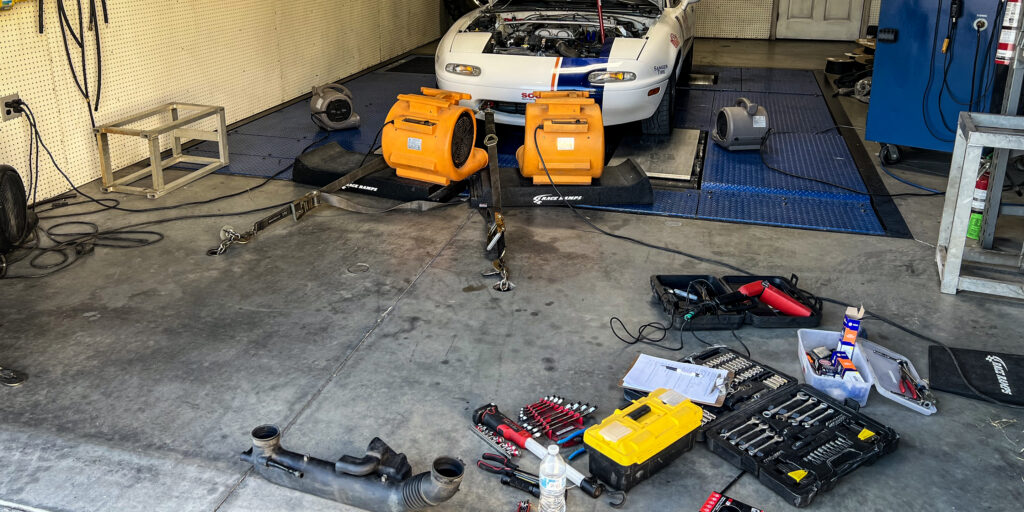
The staff will strap your car onto the dyno, run it a few times, and give you a printout of the results. If you want to make changes to improve those numbers, changes will need to be made to the car. Unless the tuner is making those adjustments for you, you’ll need to be prepared to make them yourself.
Speaking of that printout, here’s a little heads-up: You probably won’t like the results. Real-world dyno numbers depend on the machine itself, measurements at the drive wheels, the weather, the shop’s elevation above sea level, and a multitude of other factors that can affect horsepower readings. Those numbers will be lower than what your favorite YouTube car reviewer said your car makes. Don’t be discouraged. You’re not at the dyno to get a report card with a big number. You’re there to improve whatever the starting number happens to be.
Bringing the exact tools you need to adjust fuel pressure, check timing, swap spark plugs and change an intake tube or air filter will help your day go smoothly.
To improve your numbers, you need to be able to make adjustments. Depending on the car, that could involve adjusting fuel pressure and timing, flashing the ECU, trying a different air filter or muffler, or bolting on a different intake tube. To accomplish any of this, bring the exact tools required to make those changes.
During your dyno day, you’ll probably be at a race shop. If you ask the mechanic in the bay next to the dyno if you can borrow some tools from his Snap-on toolbox, you’ll quickly discover that guys who make a living with their expensive tools don’t like to share them. Save yourself the awkward moment and bring what you need.
Also, if you’re going to adjust the timing, make sure you know how to do it. Check that you have clear, easy-to-read timing marks on the engine. Dyno time goes by quickly, and the meter is always running. Be proficient at making these mechanical adjustments, and make sure you have the necessary tools before you arrive.
Personally, I like to use my own timing light because I know it’ll be the same one I’ll use at the track after replacing a head gasket. That way, I’ll have confidence setting the timing to the best horsepower number I found on the dyno, using the same timing light at the track.
Bring a Ready-to-Run Vehicle
The dyno is the place to improve performance, not get a car running. I’ve seen people show up at shops with a check engine light on. That’s a big mistake.
Modern cars have many sensors, and when the ECU detects a bad sensor, it often rolls back engine performance while allowing the car to keep running. You won’t have a successful day trying to improve performance if the ECU has already locked things down.
Additionally, just because you’ve parked your car on a shop’s dyno doesn’t mean the staff will diagnose all your car’s problems and fix them before your first pull. If you want the shop to fix the car, you’ll need to schedule that work separately and beforehand.
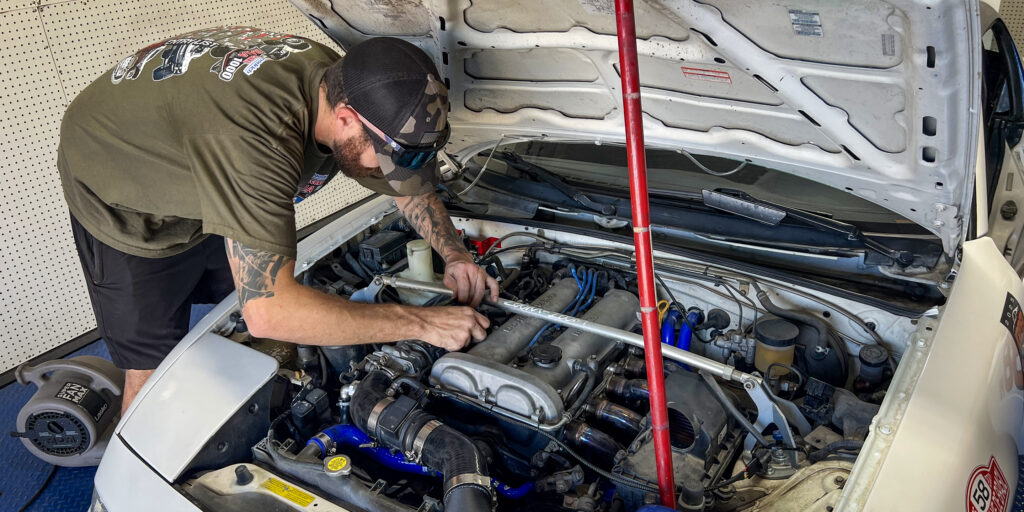
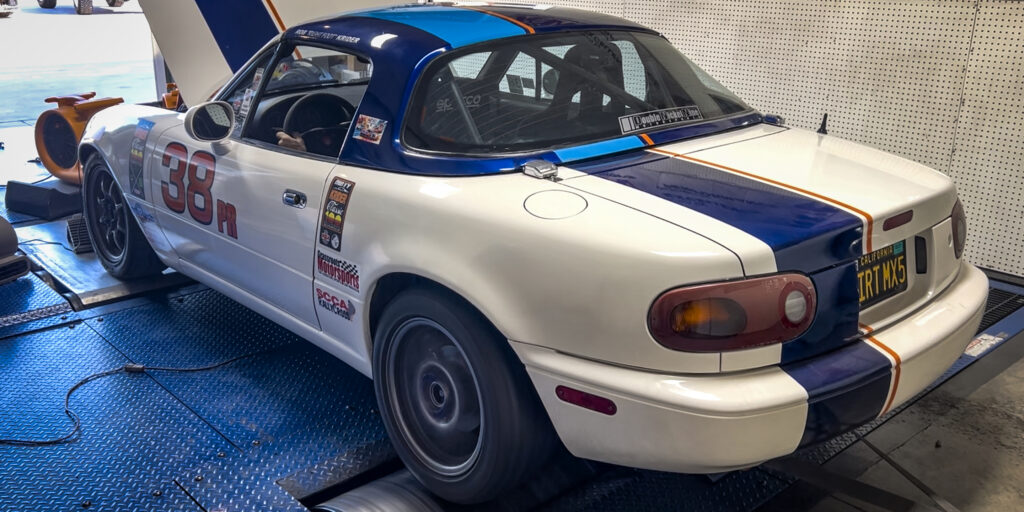
Here, Nathan Brasil at Caliber Customs is fixing my Miata, not tuning it. Had I brought the car in better condition, we would’ve spent more time tuning and less time saying, “Let’s get this Miata to run correctly.
Make sure your car has the correct amount of oil. You’ll be making multiple pulls at high RPMs, and you want to ensure the engine’s oil pump is getting what it needs. Also, make sure there’s fuel in the tank (and that it’s the same fuel you use when racing). Running out of gas on the dyno happens more often than you’d think, and it brings all progress to a halt.
The entire car needs to work, including the transmission. For your pulls, you’ll be running in the gear closest to direct drive.
If valve adjustments are a thing for your car, do that before you go. Valve adjustments need to be made with a cold engine block. Once you start making dyno pulls and everything heats up, you won’t be able to make accurate valve adjustments.
Have a Bung in Your Exhaust for an O2 Sensor
To get your combustion engine running at peak performance, the air/fuel ratio needs to be right (usually around 12.5 to 13.0 at wide-open throttle). The only way to verify that number is with an oxygen sensor (O2 sensor) that the dyno can read.
The sensor’s location is crucial. It should be installed between the header and the catalytic converter (if you have one). Placing a sensor at the exhaust tips, behind the mufflers at the rear of the car, isn’t optimal.
Tuning a car without knowing the air/fuel mixture is actually dangerous. You can permanently damage your engine. You didn’t pay to spend time on the dyno to break stuff. – you paid to make things faster.
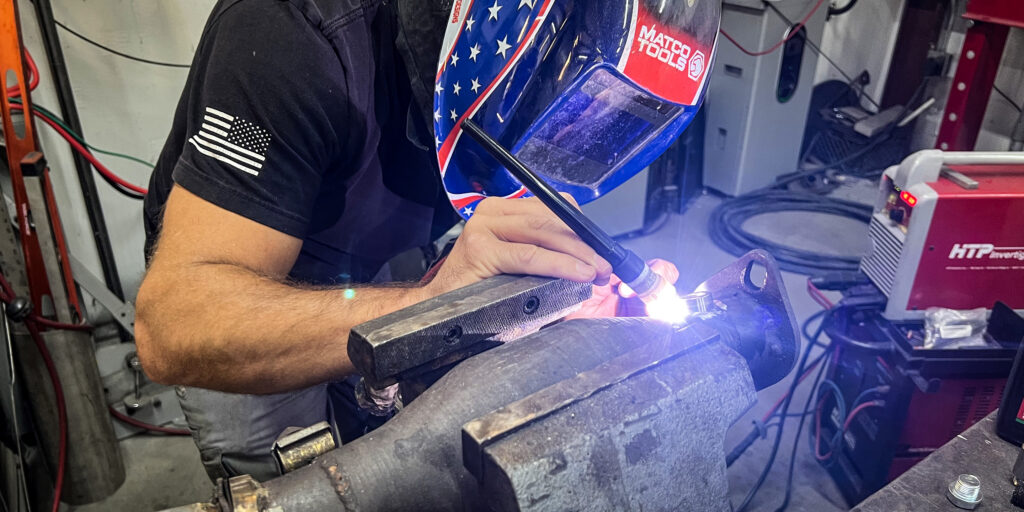
Matt Lembrecht, owner of Caliber Customs in Madera, CA, uses his fabrication skills to weld an O2 sensor bung into my Miata’s exhaust. I should’ve had this done before I showed up.
The key to making this work is having a spot in your exhaust, called a bung, where the dyno’s O2 sensor can be installed. The standard thread size for an exhaust oxygen sensor bung used with a chassis dyno’s wideband air/fuel ratio sensor is M18 x 1.5 mm.
Some aftermarket headers already have a bung, while others don’t. Figure out what your car has and take the time to get one installed before heading to the dyno. Or be dumb like me, and spend expensive dyno time welding a bung into your exhaust instead of tuning your car for better performance.
Check Your Tires and Tire Pressure
When you head to a chassis dyno, your brain is focused on the engine, which means you might be ignoring the tires. Don’t ignore your tires.
The drive wheels will be spinning on the dyno drum at speeds exceeding 100 mph. Dyno shops know this, and if they see cracks in your tire sidewalls or really old tires on your car, they may not let you make any pulls. That’s for their safety and yours.
Make sure your car has good tires, preferably with a date code less than five years old. If you’re unsure how old your tires are, check out this previous article, 5 Things to Know About Tires.
You also need to make sure your tire pressure is correct. Tire pressure can affect your horsepower numbers. The goal is to make safe, successful pulls while testing adjustments that improve performance. Having good tires at the right pressure is essential.
Have a Systematic Approach
OK, you’re on the dyno. You’ve got your tools ready, your car is running well, the O2 sensor is measuring the air/fuel ratio (AFR), and you’ve got good tires on the car. Now what?
It’s time to put your plan into action and get the most gains possible while you’re on the dyno.
I like to use a checklist and follow a specific order of operations. First, if the AFR isn’t in the correct 12.5 to 13.0 range, I’ll adjust the fuel pressure to get it there. Once that’s correct and I’ve made a few more pulls, I’ll see if advancing the timing helps improve engine performance.
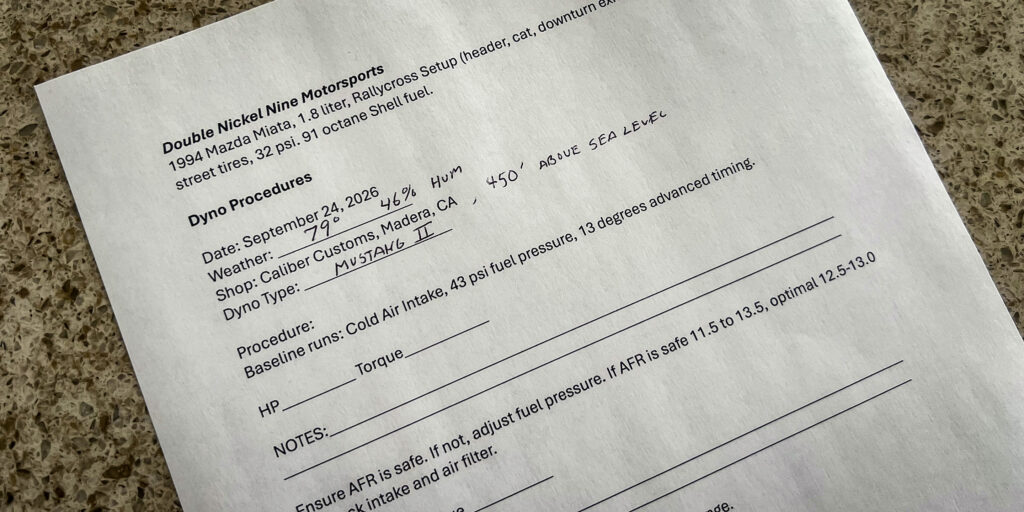
Fuel pressure and timing are the two things many Miata racers work with. Once I’ve got those two things set, I call them my baseline settings and write them down: “Fuel Pressure: 43 psi. Timing: 13 degrees advanced of Top Dead Center (TDC).”
Part of a systematic approach is using a checklist, having a plan in place and executing it one step at a time. Write down your baseline settings so you can always go back to them.
Once you’ve exhausted the possibilities for improving horsepower and torque, it’s time to move on to other things you might want to try. A different muffler? Bring gloves, because your exhaust is going to be hot. A different drop-in air filter? A different intake tube? Colder ignition plugs?
You’ll need to have these items with you, along with the tools and know-how to swap them out quickly before the next pull.
If you’re going to reflash an ECU, understand that the process can take time. Make sure you’ve got enough time to complete it before your next dyno pull. Remember, the meter is running – you’re probably being charged by the hour.
Using a systematic approach and writing down all your dyno results on a checklist is extremely helpful. What was the change? New air filter. What was the result? Plus 2 hp, minus 1 lb-ft of torque.
When you write down the changes and results, you can quickly identify what worked and what didn’t. The dyno will show you graphs of your horsepower and torque curves, but after a day on the dyno and 15 different pulls, all those graphs start to blur together. Unless the technician is making notes on each pull, you might not know which graph represents which change.
Don’t rely on the shop tech to keep track of the changes you’re making. Instead, take good notes yourself so that when you leave, you know what worked and what didn’t.
When you look at your dyno results, the horsepower and torque curves will show you whether your changes are moving you in the right direction. However, the reality is that not all changes are good. Sometimes an adjustment actually makes things worse. If that happens, go back to your baseline settings and try something else.
The goal is improvement. If you leave the dyno with more horsepower and torque than you had when you arrived, you’ve had a good day.
Seeing those numbers go up and improving performance is what we all want when spending a day (and a few hard-earned bucks) at the dyno shop. These five tips will certainly help point you in the right direction (up, up, up).
And remember, racers don’t really care about horsepower. Racers want torque!
(About the author: Rob Krider is a national champion racer, the author of the novel Cadet Blues, and the host of the Stories and Cocktails podcast.)
Photos by Rob Krider
When it comes to “official partners” of the SCCA®, the Club is picky. Partners on the “official” level must understand the wants and needs of Club members, and their company’s ethos needs to align with SCCA’s mission “to fuel a safe, fun, and exciting motorsports experience for auto enthusiasts.” When it comes to the Official insurance Partner of SCCA®, Hagerty is so cool, it hits a bullseye.
Beyond what we’ll get to in a moment, it’s important to point out an award Hagerty presents at SCCA’s National Championship events. The Hagerty Keepin’ it Cool award was presented at this year’s Tire Rack SCCA Solo® National Championships, the Mission Foods SCCA National Championship Runoffs®, the RallyCross® National Championship Presented by Bingham Equipment, and the Tire Rack SCCA Time Attack National Championship to help celebrate SCCA members who embody the spirit of the Club and Hagerty – someone who’s cool under pressure, be it during competition or in the paddock.
This year’s recipients were:
Solo National Championships: Adrian Cardenas for helping a competitor with a broken transmission.
National Championship Runoffs: Advanced Autosport for helping rebuild a competitor’s damaged race car.
RallyCross National Championship: Sean Spring for his unwavering commitment to the event.
Time Attack National Championship: Jason Anderson for, well, keepin’ it cool.
Each recipient received a Yeti cooler at the event, courtesy Hagerty.
Cooler Still…
What’s just as cool is getting savings on SCCA events, insurance discounts, free automotive content, and more – all of which Hagerty offers to support car enthusiasts with their automotive addiction.
Through the Hagerty Drivers Club, members can save $25 on entries to SCCA’s Track Night in America® Driven by Tire Rack events and Tire Rack SCCA Starting Line autocross schools, making it a great way for Hagerty members to spend less while getting more opportunities to enjoy the driving experience through SCCA events.
Of course, getting out on track is only part of the equation. Protecting the vehicles that make it all possible is important, too. Hagerty offers specialty insurance options for performance drivers, along with special endorsement programs that can provide an additional level of financial protection during motorsport events. Drivers attending SCCA Track Night events can also take advantage of discounted track insurance.
SCCA members can save even more with a 5% discount (not available in CA, TN, or MA) on Hagerty policies covering collector cars, motorcycles, and boats. Hagerty also offers race car coverage, protecting competition vehicles while they’re in storage, in the paddock, at the shop, or in transit.
There’s more to Hagerty than driving and insurance. Its commitment to the automotive community continues through Hagerty Media, where enthusiasts can find free tech tips, motorsport stories, videos, and other automotive content. Want the latest stories delivered directly to you? Sign up for Hagerty’s free newsletter.
And when it’s time to find your next automotive treasure, Hagerty has options there, too. Browse vehicles through the Hagerty Marketplace or explore auctions through Broad Arrow.
The Future
From event entry savings and insurance options to informative content and vehicle shopping, Hagerty offers SCCA members and automotive enthusiasts numerous ways to stay connected to the cars and experiences they love.
What does the future hold for Hagerty and SCCA as we head into the 2027 competition season? More good things, for sure, because when two company missions align so closely, the future is guaranteed to be cool.
Photo of Jason Anderson with his Hagerty Keepin’ it Cool Yeti cooler by Philip Royle
The 2026 SCCA® U.S. Majors Tour® included events around the country at more than 25 tracks from January to August as part of the Summit Racing Equipment SCCA Road Racing program. Enhancing the excitement across six different Conferences was a points-paying competition that engaged talented, wheel-to-wheel race car drivers throughout the season.
Within each Conference, points were awarded to the top 20 finishers in each car class. Winners earned 25 points per race, and 21 points went to runners-up. Points were then doled out to others starting with 18 and descending to a single point for the 20th finisher. Only the best eight finishes within a Conference counted towards a driver’s points total. The number of victories or best finishes a driver had in the class was then used to break ties when applicable.
Expandable menus below list 2026 U.S. Majors Tour Conference Champions. Entries include the car class, driver’s name, and SCCA Region of record. Complete points tallies can be found here.
U.S. Majors Tour® Northeast Conference Champions
– American Sedan®: Daniel Richardson, Washington DC Region – B-Spec: Richard Hromin, Washington DC Region – E Production: Tony Ave, Central Carolinas Region – F Production: James Gregorius, Finger Lakes Region – H Production: Thomas Broring, Washington DC Region – Formula Atlantic®: Robert Albani, New York Region – Formula Continental®: Richard Silver, Washington DC Region – Formula Enterprises®2: F. Russell Strate Jr, Western New York Region – Formula 600: Dino LoDico, South Jersey Region – Formula F: David Petzko, Philadelphia Region – Formula Vee®: Alexander Smith, Northern New Jersey Region – Formula X: N/A – GT-1: James Wilson, Philadelphia Region – GT-2: Tom Patton, Cincinnati Region – Spec Miata: Christian Sarnecki, New England Region – Spec MX-5: Camden Gruber, Washington DC Region – Spec Racer® Ford Gen3: Michael Perrotti, New York Region – Prototype (tie): Darryl Shoff, Northeastern Pennsylvania Region / Jason Fraley, Susquehanna Region – Prototype 2: Sherman Chao, Central Florida Region – Super Touring® Lite: Derek Ketchie, Central Carolinas Region – Super Touring® Under: Darin Treakle, Washington DC Region – Touring 1: Brian Kleeman, Washington DC Region – Touring 2: Russell King, Land O’Lakes Region – Touring 3: Colin Duffy, New England Region – Touring 4 (tie): Gabe Fehribach, Southern Indiana Region / Kevin Fryer, Washington DC Region / Owen Schefer, Washington DC Region / Thomas Bogar, New England Region
U.S. Majors Tour® Northern Conference Champions
– American Sedan®: Andrew McDermid, Detroit Region – B-Spec: Caleb Patrie, Milwaukee Region – E Production: Jon Brakke, Land O’Lakes Region – F Production: David Bednarz, Detroit Region – H Production: Steve Sargis, Blackhawk Valley Region – Formula Atlantic®: James Smart, Milwaukee Region – Formula Continental®: Brian Tomasi, Chicago Region – Formula Enterprises®2: Dean Oppermann, Chicago Region – Formula 600: James Weida, Indianapolis Region – Formula F: Brandon Lavender, Ohio Valley Region – Formula Vee®: Andrew Whitston, Milwaukee Region – Formula X: Steve Johncock, Western Michigan Region – GT-1: Dave Ruehlow, Milwaukee Region – GT-2: Ike Keeler, Western Michigan Region – Spec Miata: Tyler Brown, Milwaukee Region – Spec MX-5: Marcello Cusma, Milwaukee Region – Spec Racer® Ford Gen3: Bobby Sak, Detroit Region – Prototype: Gary Peck, Blackhawk Valley Region – Prototype 2: Richard Colburn, Cincinnati Region – Super Touring® Lite: Bill Collins, Land O’Lakes Region – Super Touring® Under: Tony Ave, Central Carolinas Region – Touring 1: Roy Lipner, Chicago Region – Touring 2: Aaron Kaplan, Chicago Region – Touring 3: John LoGiudice, Milwaukee Region – Touring 4: Richard Mooney, Milwaukee Region
U.S. Majors Tour® Southeast Conference Champions
– American Sedan®: Michael Kamalian, Atlanta Region – B-Spec: Josh Schmidt, North Carolina Region – E Production: Peter Norton, North Carolina Region – F Production: Cliff Ira, Buccaneer Region – H Production: Michael Miller, Central Carolinas Region – Formula Atlantic®: Dudley Fleck, Iowa Region – Formula Continental®: Chris Scharnow, Central Florida Region – Formula Enterprises®2: Paul Schneider, Central Carolinas Region – Formula 600: H. McLeod, Central Carolinas Region – Formula F: John Robinson II, Central Florida Region – Formula Vee®: Anthony Henderson, Chattanooga Region – Formula X: Lazaro Bainotti, Florida Region – GT-1: Joseph Freda, Arkansas Region – GT-2: Jack Stanford, Atlanta Region – Spec Miata: Travis Wiley, Central Carolinas Region – Spec MX-5: Skyler Cottrell, Atlanta Region – Spec Racer® Ford Gen3: Brian Schofield, Central Florida Region – Prototype: Wade Richardson, Alabama Region – Prototype 2: Sherman Chao, Central Florida Region – Super Touring® Lite: Nick Leverone, New England Region – Super Touring® Under: Edwin Soto-Quinones, Puerto Rico Region – Touring 1: Wes Humphryes, Alabama Region – Touring 2: James Davidson, Florida Region – Touring 3: Thomas Burt, Central Florida Region – Touring 4: Kevin Fryer, Washington DC Region
U.S. Majors Tour® Mid-States Conference Champions
– American Sedan®: Timothy White, Colorado Region – B-Spec: Paul Jensen, Continental Divide Region – E Production: Cameron Wogrin, Colorado Region – F Production: Mark Weber, St. Louis Region – H Production: Chris Albin, Southern Illinois Region – Formula Atlantic®: Jonathan Cottrill, Colorado Region – Formula Continental®: Bill Johnson, Kansas City Region – Formula Enterprises®2: Darryl Wills, Houston Region – Formula 600: Timothy Friest, Kansas City Region – Formula F: Nathan Down, Colorado Region – Formula Vee®: Phillip Holcomb, Colorado Region – Formula X: Michael Lauer, Wichita Region – GT-1: Stephen Wiles, Kansas City Region – GT-2: Boyd Lear, Colorado Region – Spec Miata: Roman Perez, Colorado Region – Spec MX-5:Ed Keturakis, Washington DC Region – Spec Racer® Ford Gen3: Michael Cameron, Colorado Region – Prototype: Kirk Kindsfater, Colorado Region – Prototype 2: N/A – Super Touring® Lite: Jackie Ruegsegger, Colorado Region – Super Touring® Under: James Mullen, Colorado Region – Touring 1: Michael Pettiford, Colorado Region – Touring 2: John Argrow, Colorado Region – Touring 3: Michael Pettiford, Colorado Region – Touring 4: Connor Thomas, Colorado Region
U.S. Majors Tour® Southern Conference Champions
– American Sedan®: Ross Murray, Cal Club Region – B-Spec: James Rogerson, Houston Region – E Production: Larry Svaton, Houston Region – F Production: Stephen Simonds, Houston Region – H Production: Jesse Prather, Kansas Region – Formula Atlantic®: Jarret Voorhies, Central Florida Region – Formula Continental®(tie): Bill Johnson, Kansas City Region / William Trimbur, Houston Region – Formula Enterprises®2: Darryl Wills, Houston Region – Formula 600: Carl Maier, Texas Region – Formula F: Andrew MacDougall, Colorado Region – Formula Vee®: Charles Cochran, Texas Region – Formula X: Paul Ravaris, Texas Region – GT-1: David Fershtand, Texas Region – GT-2: Paul Ruth, Texas Region – Spec Miata: John Hamner, Texas Region – Spec MX-5: Gavin Vaughan, Houston Region – Spec Racer® Ford Gen3: Joseph Maley, Houston Region – Prototype: N/A – Prototype 2: Marvin Hodges, Houston Region – Super Touring® Lite: Charles Mathes, Houston Region – Super Touring® Under: Peter Federlin, Lone Star Region – Touring 1: Luis Esteves, Texas Region – Touring 2: Christopher Miranda, Texas Region – Touring 3: Michael Meek, Texas Region – Touring 4: Leann Falk, Texas Region
U.S. Majors Tour® Western Conference Champions
– American Sedan®: Ross Murray, Cal Club Region – B-Spec: Thomas Lepper, San Francisco Region – E Production: Joe Carr, San Francisco Region – F Production: Daniel Snow, Cal Club Region – H Production: Brian Linn, Cal Club Region – Formula Atlantic®(tie): Greg Labadie, Cal Club Region / James Blackwell, Northwest Region – Formula Continental®: Bill Wallschlaeger, Arizona Region – Formula Enterprises®2: Jon McClintock, Oregon Region – Formula 600: N/A – Formula F: Edward Erlandson, Cal Club Region – Formula Vee®: Quinn Posner, Northwest Region – Formula X: Tao Takaoka, San Francisco Region – GT-1: Michael McAleenan, Northwest Region – GT-2: Igor Lyustin, San Francisco Region – Spec Miata: Jason Rawlins, Oregon Region – Spec MX-5: Bryce Johnson, San Francisco Region – Spec Racer® Ford Gen3: Asad Nikadambaev, Northwest Region – Prototype: Jim Devenport, San Francisco Region – Prototype 2: Tim Day Jr., San Francisco Region – Super Touring® Lite: Jared Korth, San Francisco Region – Super Touring® Under: Rylan Hazelton, San Francisco Region – Touring 1: Ed Gless, Northwest Region – Touring 2: Rylan Hazelton, San Francisco Region – Touring 3: Gamaliel Aguilar-Gamez, Northwest Region – Touring 4: Izzy Sanchez, Cal Club Region
3-2-1
There were as many as 25 different car classes in each Conference that could crown a Champion this year. The competition was stiff, and many Conference class Championships were decided by the slightest of margins.
A trio of points decided three Conference Champions. That included the Southeast Conference Prototype field in which Wade Richardson emerged victorious by three points over both Darryl Shoff and Lawrence Loshak. The same Conference saw a three-point spread in Spec MX-5, which was won by Skyler Cottrell over Jarrett Jones, followed by Weston Duchak a single point behind Jones. Touring 1 in the Southeast Conference also came down to three points with Wes Humphryes triumphant over James Candelaria.
Two points was the difference between Champions and runners-up in multiple Conferences. That was the spread in the Northern Conference when it came to Formula F with driver Brandon Lavender taking the top spot over Nic Sheppard. B-Spec saw the same thing in the Northeast Conference as Richard Hromin took down the title by two points over Zach Introne, and Brian Price was only two points further back.
The Northeast Conference also had a two-point difference in Formula Vee® as Alexander Smith won out over David Scaler. The same spread was the deciding factor in the same Conference when it came to the Spec MX-5 field, which Camden Gruber won over Michael Tinis.
The Southeast Conference was no stranger to two-point finishes either, starting with Formula Continental® driver Chris Scharnow taking the class Championship over Brandon Dixon. That Conference’s GT-2 battle was also decided by a pair of points as Jack Stanford emerged victorious over Stephen Sauers.
A couple of Conference Championships were even decided by a single point, including Formula 600 in the Northeast Conference where Dino LoDico claimed the crown by one point over Jay Beckley. The Southeast Conference then saw its Spec Miata class Championship come down to a solo point, too, as Travis Wiley finished the season atop the 136-entrant class by a single point over Bobby Gossett.
Totally Tied
The fact there are several Co-Champions in various classes across a few Conferences attests to the tight competition found within the U.S. Majors Tour. Take for instance the Northeast Conference’s Prototype class with Co-Champions being Darryl Shoff and Jason Fraley. That Conference also had a four-way tie for first in Touring 4 with Co-Champions being Gabe Fehribach, Kevin Fryer, Owen Schefer and Thomas Bogar.
The “tie” theme continued with Formula Continental in the Southern Conference as Bill Johnson and William Trimbur share the Championship there. The Formula Atlantic® battle in the Western Conference also sported a tie between Greg Labadie and James Blackwell; and Formula Atlantic in the Southern Conference has a points tie between Jarret Voorhies and Broch Evans. However, Voorhies claims the Championship in this instance on the strength of multiple runner-up results over the season.
Double Championships for Some
Eight devoted sports car aces managed to claim multiple Conference Championships. The list of those who doubled up in 2026 season is as follows:
Tony Ave: E Production (Northeast Conf.), Super Touring® Under (Northern Conf.)
Photo of STU and T2 Western Conference Champion Rylan Hazelton by Jay Bonvouloir
The Sports Car Club of America’s™ championship season is over, but we had to await the final SCCA® National Championship event that came at the end of October to mark down the last entry in the officially-unofficial Solo® Nationals record book called the “Solo Stats” (created and maintained by yours truly) – this final event coming almost two months after the completion of the 53rd Tire Rack SCCA Solo National Championships, which is the foundation of the “Solo Stats” book. The holdup in this process was the completion of the “Crossover Champions” section of the record book, recording those who have won National Championships in Solo as well as another of SCCA’s competition disciplines. And it’s a good thing I waited, because this year introduced the Triple Threat.
In the inaugural year of the Tire Rack SCCA Time Attack National Championship (the aforementioned late October event) came the first “Triple Threat” for SCCA’s winner-take-all events in the name of Kansas Region member Eric Prill (who is also SCCA’s Vice President of Road Racing). Prill has won three times at the SCCA National Championship Runoffs® in an F Production Miata (2017, 2019, and 2022). He then added a Solo National Championship title with a D Modified win in 2019 co-driving a Locost 7 with Bob Tunnell. This year, he won the Club Spec MX-5 class at the Time Attack National Championship at Eagles Canyon Raceway in Texas.
Adding to the record book of Crossover Champions this year also includes Texas Region’s David Whitener, who is a five-time Solo National Champion in Street Touring Sport and Street Touring FWD classes, and this year he topped the Max 5 class at Eagles Canyon. Brian Peters, Phoenix AZ Solo Region, is an eight-time Solo National Champion in eight different classes, who won Tuner 2 this year in Time Attack. And finally, Scotty B. White, Northwest Region, was the Street Mod 2 National Champion in 2003 who won a Runoffs crown this year in Touring 2.
Now, back to strictly Solo National Championships record stuff.
The above information, as well as the information below (plus info and stats on every single driver who has ever competed at SCCA’s Solo National Championships), is available in my “Solo Stats” book, which you can order from Amazon by clicking here. A searchable PDF version is available by contacting me directly at [email protected].
In assembling this year’s “Solo Stats” book, some fascinating information caught my eye, like…
The Most (Open)
We have Cal Club Region’s Jeff Kiesel, strictly an autocrosser, who now owns the Most (Open class) Championships record at 19, 18 of them in his green E Mod Sprite after his maiden 2006 BP win in a Mazda RX-7. This year’s victory broke him out of an 18-win tie with John Thomas (who was second in DP this year).
Along with Kiesel’s record-breaking Open victory, plus daughter Kaila Kiesel’s score in EML, the Kiesel family, including wife Shawn and son Zak, now own 40 championship trophies – a monstrous score to top the Family Championships category by fully 15 wins.
Longest Gap
At the other end of the spectrum we have Bill Green of Colorado Region, who was driving in his fourth Solo Nationals, bringing up the rear in EVX with a Tesla Model 3. The thing is, his third Nationals was in 1977, 49 years ago! That one was a trophy finish, second in G Stock. Green now owns the record for the longest gap between two Solo Nationals appearances, set just two years ago by Boyd Butler of Utah Region who’d returned 41 years after his previous appearance.
After bringing his Opel GT to the 1975 Solo Nationals in Salina, KS, Green said, “I started driving my parents’ 1971 Datsun 1200 and found it was really competitive in G Stock.” He was GS runner-up two straight years, then completed a mechanical engineering degree at the University of Colorado. “Between my career and raising kids, I didn’t autocross again until my oldest son turned 16.” Both of his sons are now autocrossers too.
“Remarkable how advanced cars have become,” Green added, “as I was driving back from Lincoln in Tesla full self-driving mode,”
More Hardware
SCCA has 115 individual Regions, seven of them never having a trophy winner at the Solo National Championships. This year, the “never” list drops to six: Nathan Hagerott is the first Region-of-record member from Great River Region to claim a Solo Nationals trophy, fourth place in H Street in just his second trip to Lincoln.
The trophy tally shows a pair of record setters on the Ladies side. Ginette Jordan of New Englnd Region won FSPL and caught up to Patty Tunnell for the most trophies won by a female driver. Both are at 26 trophies now. Meanwhile, Nicole Wong of Phoenix Region extended her string to 17 years of taking a trophy every year she’s competed. Wong also moved into a five-way tie among drivers who have won in the most different categories. Her CAMCL victory is the fifth different category among her 15 championships.
The same distinction among male drivers has Mark Daddio stretching his margin ever farther, his 34 trophies tops not only the won-every-year list but also the tally for most consecutive trophy finishes.
The Big Time
1,305 drivers crossed the lights this year, the third-largest Solo Nationals and the largest since the record year of 1,375 in 2018. Categories producing new highs on the entry list were the Spec classes (138), CAM (122), Xtreme (121), and the 14 EVXs were the most in its five years.
2026 was also the year “Supplemental” classes disappeared. Oh, there were still three classes running on something other than championship status, but the word “Supplemental” was gone. Xtreme Unlimited (XU) was declared to be a “Developmental” class, while both Formula SAE And Electric Vehicle (EVX) were deemed to be “Exhibition” classes.
That meant the popular CAM classes and the other two strongly supported Xtreme classes were full-fledged championship classes this year, both with record entries. In its first appearance in 2014, the three CAM classes produced 14 entries. CAM-Ladies did not exist until four years ago. This year, 122 competitors battled in the CAM category.
The 60 drivers in XA and 57 in XB comprise the two largest Xtreme classes yet in the brief five years of their existence. Including XU, Xtreme fielded 123 drivers.
And take a look at Keith Lamming of Kansas City Region. He was a class winner that first year, taking CAM-Contemporary – the largest class (seven cars) in a 2011 Camaro. Now, with full championship status for the first time, Lamming was right there again driving this year in CAM-Traditional, again in the largest of the CAM classes at 43 cars. This time Lamming was in a ’68 Camaro and once again on the top step of the podium.
Silver Circle and 100 Percenters
The Silver Circle added seven names to the list, bringing the total to 194 drivers who have competed in 25 or more Solo Nationals. The new members are Wayne Atkins, Texas Region; Annie Gill, Northwest Region; David Green, Wichita Region; James Harrison, Wichita Region; Scott Hearne, Northwest Ohio Region; Pilar Miranda, San Francisco Region; and Heyward Wagner, Atlanta Region.
The 100 Percenter group has now dropped to just four names after PAX guru Rick Ruth failed to make the trip. The four who have now competed in all 53 Nationals are Dick Berger, Kansas City; Charlie Clark, Kansas City; Rocky Entriken, Salina; and George Schweikle, Central Kentucky.
About the author: Rocky Entriken is the official historian of the Tire Rack SCCA Solo National Championships. His record book of the event, titled “Solo Stats,” contains more than 700 magazine-size pages of history and statistics of the event from 1973 onward, including the placings of everyone who has ever put a wheel through the lights at the Solo Nationals. The book is available on Amazon.com. Or, a searchable PDF version is available by contacting him directly at [email protected].
(Editor’s note: This article has been updated to correct the number of National Championships Nicole Wong has earned, as well as clarified Jeff Kiesel’s record.)
(Photo of Bill Green competing at the 2026 Tire Rack SCCA Solo National Championships, some 49 years after his last appearance at the event, by Jeff Loewe)
In the coming year, the Tire Rack SCCA Time Attack Challenge will once again traverse the country, bringing with it access to some of the best tracks and finest competition. The 2027 season will also mark the running of the series’ second National Championship event – at a new location! All said, the coming season’s schedule boasts nine unforgettable opportunities for drivers to push themselves to the limit in pursuit of personal bests, track records, and (of course) wins.
And, hey, guess what? You’re invited!
From bone stock commuters to maxed-out competition vehicles and everything in between, SCCA’s Time Attack Challenge pits drivers against not only themselves and the clock, but also some of the best Time Attack competitors in the nation, all in fantastically fun weekends. Time Attack Challenge events see everyone from first-time track goers looking to add to their personal motorsport growth to championship-caliber drivers using every opportunity to sharpen their skills. Regardless of car and driver level, each weekend features parties, on-site camping, and camaraderie that keeps people coming back for more.
“We’ve spent time dialing in the competition-to-fun ratio, and the 2027 season really showcases that,” says SCCA Vice President of Experiential Programs Heyward Wagner. “From the season’s opener in a city that oozes fun to hidden gems and more, this coming year features something for everyone. If you’ve ever thought about attending an SCCA Time Attack Challenge, we’ve got a weekend for you.
“I’m also super excited we’re adding GRM Cup to seven of the Time Attack weekends. All combined, I can’t wait for the season to begin.”
Take the Challenge
The 2027 Tire Rack SCCA Time Attack Challenge kicks off just like it did in 2026, because jumpstarting any series in Las Vegas is no gamble. The outside road course at Las Vegas Motor Speedway is one of those hidden gems, mixing speed with technical to create a circuit that can’t be beat – and like last year, mid-February is when Time Attack drivers will take to this circuit.
From there, the series heads east for a stop at Eagles Canyon Raceway in Decatur, TX, for a late April event. This location has proved popular with drivers, making a return to the facility a no-brainer.
Then we get into the thick of things with a slew of events taking place in June, July, and August.
Missouri and Hedge Hollow Raceway jumpstart summer with an incredible opportunity on June 12-13 as the Time Attack Challenge makes its first appearance at the relatively new racing circuit. Opened in 2019 as a private facility then later opened to the public, the Alan Wilson-designed track mixes high speed straights with technical portions to challenge cars and drivers. In short, you’re going to love it.
The next stop comes in South Carolina on June 19-20 at Carolina Motorsports Park, followed on July 10-11 with an event in Georgia at Atlanta Motorsports Park. Next comes a trip to Pennsylvania’s Pocono Raceway one week later, July 17-18, with mid-August bringing another West Coast event at Ridge Motorsports Park in Washington. All of those tracks are classics in their own right.
All of the aforementioned Time Attack Challenge events include GRM Cup events.
Technically, the series wraps in November at southern California’s Buttonwillow Raceway Park, but that comes after the Tire Rack SCCA Time Attack National Championship.
The 2027 National Championship event falls on Oct. 7-11 at Autobahn Country Club in Joliet, IL. Autobahn has long been a fan favorite, making it a natural fit to host the second annual Time Attack National Championship.
Calendar and More
The 2027 Tire Rack SCCA Time Attack Challenge calendar can be found below. Note that the first seven weekends also include the new GRM Cup series.
2027 Tire Rack SCCA Time Attack Challenge and GRM Cup Calendar
Feb. 20-21: Las Vegas Motor Speedway, Las Vegas, NV (Includes GRM Cup)
April 24-25: Eagles Canyon Raceway, Decatur, TX (Includes GRM Cup)
June 12-13: Hedge Hollow Raceway, Adrian, MO (Includes GRM Cup)
June 19-20: Carolina Motorsports Park, Kershaw, SC (Includes GRM Cup)
July 10-11: Atlanta Motorsports Park, Dawsonville, GA (Includes GRM Cup)
July 17-18: Pocono Raceway, Long Pond, PA (Includes GRM Cup)
Aug. 21-22: Ridge Motorsports Park, Shelton, WA (Includes GRM Cup)
Oct. 7-11: Time Attack National Championship at Autobahn Country Club, Joliet, IL
Nov. 13-14: Buttonwillow Raceway Park, Buttonwillow, CA
Voting for the 2027 SCCA H Production Hall of Fame is now open. Created by the H Production Nationwide Points Championship (HPNPC) and now in its third year, the HP Hall of Fame will induct up to three legendary drivers, crew, fabricators, and/or volunteers that were instrumental in the H Production class over its 70-plus year history in the SCCA®.
Any past or present SCCA member is eligible to vote for up to three of the nominees each year. The polls are now open and will close at 11:59 p.m. EST on Nov. 30, 2026.
The selection committee will take the top five vote receivers, and induct up to three individuals to represent the 2027 class. These individuals will join 2025 inductees Randy Canfield, Cat Kizer, and Ray Stone, along with 2026 inductees Ron Bartell and Steve Sargis, as members in the SCCA H Production Hall of Fame. Inductees will be notified in early December, with a public announcement coming later in the month.
The induction ceremony will be held during the HPNPC’s marquee event, the Captn Mikee Cummings H Production Invitational, held at the Mid-Ohio Sports Car Course on Aug. 7-8, 2027 (tentative date). The invitational gives a real “mid-season Runoffs®” feel, with a dedicated run group just for HP, a 20-lap feature race with a victory lap, and group dinner parties. In the first five years of the Invitational’s existence, more than 30 H Production cars were entered each year, making it the largest non-Runoffs event for the H Production class. However, the really special part of the invitational weekend is the coming together of the H Production family.
There’s an eclectic mix of Runoffs champions, perennial national contenders, local Regional racers, SCCA novices, and even retired HP racers who attend, with pictures, videos, and stories shared throughout the weekend. It truly is a one of a kind grassroots event that pays homage to the past and is a must-see event for anyone who loves the foundation and core of SCCA Road Racing.
An impressive $11,500 in scholarships highlight SCCA Women on Track’s 2027 program, and all women eager to grow their motorsports skills are encouraged to apply for a chance to get in on the action.
Each year, SCCA Women on Track, funded by the SCCA Foundation, helps women take the next step in their motorsports journeys by distributing thousands of dollars in scholarships, with this year continuing that tradition with scholarships providing financial assistance to help reduce the barriers for participation.
Whether the goal is chasing cones in Solo®, tackling a RoadRally, hitting the dirt in RallyCross®, taking the green flag in an SCCA Road Racing event or Time Attack, or getting trackside by volunteering, there’s a scholarship opportunity for you. Note that while you don’t have to be an SCCA member to apply for any SCCA Women on Track scholarship, membership may be required to participate in the associated event.
Applications for the 2027 scholarships are open now, but the clock is ticking on all of the opportunities. Application deadlines range from Jan. 15 to May 31, 2027, depending on the scholarship.
Below is a list of the available scholarships and deadlines. Check them out, then click this link to apply.
2027 SCCA Women on Track Scholarships
Wendi Allen Solo Scholarship Application deadline: Jan. 15, 2027
Offered in partnership with Mazda, this scholarship will award three recipients $1,500 each to help cover travel to Tire Rack SCCA National Solo events and/or the Tire Rack SCCA Solo National Championships.
Road Racing Driver Scholarship
Application Deadline: March 15, 2027
Ready to get on track? Two women will each receive $1,000 to help with the cost of attending an SCCA competition Drivers’ School or a Race Experience event.
Runoffs Volunteer Scholarship
Application Deadline: May 31, 2027
This scholarship represents the women who volunteer at the Runoffs, helping host SCCA’s winner-take-all National Championship event. Two recipients will receive $500 each to help cover event-related expenses.
RallyCross Scholarship
Application Deadline: May 31, 2027
For women looking to kick up some dirt, two $500 scholarships will help offset expenses associated with attending either the 2027 RallyCross National Championship or a RallyCross Divisional Challenge event.
Time Attack Scholarship
Application Deadline: Jan 15 and May 31, 2027
There are three opportunities to get financial support for Time Attack competition. Two applicants will each receive $500 toward attending a Time Attack Challenge weekend, while one additional recipient will receive $1,000 to help with attendance at the Tire Rack SCCA Time Attack National Championship.
The deadline for the Time Attack Challenge scholarships is Jan. 15, 2027, while applications for the Time Attack National Championship scholarship are due May 31, 2027.
RoadRally Scholarship Application Deadline: May 31, 2027 For those looking for the thrill of a street-legal RoadRally competition, two $500 scholarships will help cover the cost of attending the 2027 United States RoadRally Challenge®.
Funding for SCCA Women on Track initiatives comes from the SCCA Foundation, a 501(c)(3) not-for-profit organization whose mission is to support the Sports Car Club of America™ by providing inclusive opportunities for motorsports competition, safety, education, and historical preservation through such programs as SCCA Women on Track, SCCA Archives, Tire Rack Street Survival, and more.
Head to the SCCA Foundation’s website to discover more about the not-for-profit charitable organization, along with how you can help support the Foundation and its initiatives.
Photo by Emerson Welch
There’s a special kind of awesome that happens when someone takes their first laps on a racetrack. The nerves. The excitement. The grin. Want a front-row seat for that joy? Better yet, want to help make it happen? Welcome to SCCA® Track Night in America® Driven by Tire Rack (TNiA), where nobody needs a motorsports résumé to join the party.
Track Night was built around the concept that driving on a racetrack should be accessible to all. No previous track experience? No problem! Track Night offers fun-forward track time where a great attitude is all that’s needed. (Oh, and a car and a helmet, but that’s all.) Track Night supplies the rest.
The idea was a hit from day one. Over the past decade, over 90,000 drivers have sampled the good stuff at more than four dozen venues nationwide. Roughly 1,400 events have been made possible by the people who show up behind the scenes to keep the whole operation rolling.
The real horsepower behind Track Night’s success are the coaches, event leaders, administrators, photographers, and other dedicated enthusiasts who want to turn a few hours at the track into an experience other drivers can’t stop talking about.
Got a knack for helping others have a great time? Help newcomers find their feet, learn the ropes, and get the most out of their time behind the wheel. Prefer organizing the event? Event leadership and administrative support keep things running smoothly. Have an eye for a great shot? Photographers help capture the moments drivers will be bragging about long after the tires cool down. And if none of those roles quite fit, there are other ways to get involved, too.
As Track Night gets ready to roll into 2027, we’re looking for more good humans to join the crew. The mission is simple: combine enthusiasm with education, make every event welcoming, and send drivers home happy.
While several positions offer some form of compensation, all offer a chance to be part of something special.
If helping people discover their inner track junkie sounds like your kind of fun, get involved by clicking the link below.
Here’s the thing: it’s a big one. The weekend will run on the 13CW configuration, which is the de facto Time Attack course in the U.S. Oh, and it just so happens to share the weekend with Global Time Attack’s (GTA) season finale.
Whether you’re chasing a personal best, battling for class honors, or looking to finish the season strong, this is the place to put it all on the line – and you’ll know exactly where you stand leaving the weekend.
If two days aren’t enough, Friday features a dedicated test day hosted by GTA, giving participants valuable seat time to shake down new parts, fine-tune setups, and dial in their cars before competition begins. It’s the perfect opportunity to arrive confident and ready.
The weekend runs in the format that’s familiar to SCCA Time Attack participants. Saturday features a practice session followed by three timed sessions; Sunday adds two more sessions. The best time in the Time Attack 1 and Time Attack 2 periods are added together, and the lowest time wins.
But back to the layout: Buttonwillow’s 13CW is the ultimate “if you know, you know” course. Slow speed corners, mid speed turns, and fast, blind crests can all be found here. It’s become the ultimate proving ground, both for Time Attack drivers and beyond. If a race team or manufacturer wants to test something, it often happens on the 13 clockwise configuration.
Riverside, Cotton Corners, and Phil Hill are all legendary turns found on 13CW.
The last thing you need to know? Registration is already open. If you haven’t signed up already, what are you waiting for? Be part of the event by heading to the event page for more info and registration.
The Hoosier Racing Tire SCCA® Super Tour, part of the Summit Racing Equipment SCCA Road Racing Program, made nine stops in 2026 at sensational venues across the United States for a total of 18 races. Some of the country’s best amateur road racers came out to have #funwithcars from February to late August – and put on one heck of a show.
As always, adding to the excitement was the season-long Super Tour Nationwide Points Championship chase. Tallied up were a driver’s six best Hoosier Super Tour races within a single car class, plus their finish at the 2026 Mission Foods SCCA National Championship Runoffs®. Competitors earned 25 points per race victory, with second place laying claim to 21 points. Third earned 18 points, and so on through 20th place, who earned a solitary point. In cases where there was a tie in points, the person who finished higher at the Runoffs was awarded the better position within the Nationwide Points Championship.
Close Competition
While several of the 24 different Nationwide Points Championships were solidly cemented by competitors, a handful of classes were decided by a scant few points. B-Spec was one such class where only eight points decided the victor, that being Josh Schmidt over Chris Taylor in a field with nearly 60 entrants. That effort netted a second consecutive B-Spec Nationwide Points Championship for Schmidt.
Five points was the deciding factor in American Sedan®. Michael Kamalian was triumphant there, with Ross Murray claiming the runner-up spot. Five points was also the spread between Touring 1 Nationwide Points Championship winner Wes Humphryes and second-place finisher Richard Grant, followed by Ed Gless, who was only three points further back in third.
A couple classes were decided by only three points, and that included Formula Atlantic®, where John Mcaleer grabbed the Points Championship by amassing three more points than Dudley Fleck. Spec MX-5 (SMX) also came down to three points, with Cam Ebben sitting atop the 50-entrant class. Perhaps more impressive was the fact that the top five finishers at the end in SMX were separated by six points. William Wallis was runner-up with 144 points, and Camden Gruber third with 141 points. Tied with 138 points were Jarrett Jones and Christian Hoagland; Jones finished better than Hoagland at the Runoffs, so he claimed fourth in the standings, and Hoagland ended the year fifth.
Ties Decided
Two classes came down to a tie in 2026.
In Prototype, Todd Vanacore and Darryl Shoff each ended the season with 96 points. Vanacore’s fourth-place performance at the Runoffs sealed the deal and his Nationwide Points Championship. Further proving the tight battle at the top of the Prototype field was Gary Peck, who completed his year only two points behind Vanacore and Shoff.
As for Formula Vee®, the season’s Points Championship ended up being a battle amongst siblings. Zachary Whitston and Andrew Whitston closed their year with 156 points each, followed by Steve Whitston in third with 142 points. The Runoffs was very much the deciding factor for this trio, with Steve performing best, having earned the silver medal at Road America. Zachary grabbed the bronze medal in Wisconsin, and Andrew finished just off the podium in fourth. But as the Nationwide Points Championship goes, Zachary’s result locked down the top spot and bragging rights.
An Elite Season
While kudos goes out to all the Nationwide Points Champions this year, special recognition is due to Tony Ave. He managed to claim three Points Championships in 2026; those being in GT-2, Super Touring® Under, and E Production.
In GT-2, Ave achieved the top spot by accumulating 151 points, as compared to the 125 points earned by runner-up Jorge Nazario. Ave also pulled together 131 points to lead the E Production class as compared to the 117 points gathered by second-place finisher Jon Brakke during the season. Finally, in Super Touring Under, Ave ended up with 11 points more than runner-up Peter St. Pierre; David Fiorelli finished third only a dozen points back.
Click the link below for a complete look at the full points rundown for all classes.
Below is the list of 2026 Hoosier Super Tour Nationwide Points Championship winners with class, name, and SCCA Region of record. Complete points results for all Hoosier Super Tour classes can be viewed here.
American Sedan®: Michael Kamalian, Atlanta Region
B-Spec: Josh Schmidt, North Carolina Region
E Production: Tony Ave, Central Carolinas Region
F Production: Mason Workman, Ohio Valley Region
H Production: Steve Sargis, Blackhawk Valley Region
Formula Atlantic®: John Mcaleer, Atlanta Region
Formula Continental®: Brandon Dixon, Alabama Region
Formula Enterprises®2: Sebastian Mateo Naranjo, Central Illinois Region
Formula 600: James Weida, Indianapolis Region
Formula F: David Ybarra, Texas Region
Formula Vee®: Zachary Whitston, Lone Star Region
GT-1: Adam Romito, Wiregrass Region
GT-2: Tony Ave, Central Carolinas Region
Spec Miata: John Salerno, New England Region
Spec MX-5: Cam Ebben, Milwaukee Region
Spec Racer® Ford Gen3: Tyler Stephens, Northeast Oklahoma Region
Prototype: Todd Vanacore, Central Florida Region
Prototype 2: Richard Colburn, Cincinnati Region
Super Touring® Lite: Nick Leverone, New England Region
Super Touring® Under: Tony Ave, Central Carolinas Region
Touring 1: Wes Humphryes, Alabama Region
Touring 2: William Bolt, Atlanta Region
Touring 3: Nic Hammann, Kansas City Region
Touring 4: Madin Workman, Ohio Valley Region
Photo of Tony Ave, GT-2 Super Tour Point Champion, by Jay Bonvouloir
For decades, the Sports Car Club of America™ (SCCA®) and Grassroots Motorsports (GRM) have helped automotive enthusiasts turn an interest in cars into something they can experience behind the wheel. Now, the organizations are strengthening that relationship around a shared goal: making motorsports more accessible through DIY, approachable, budget-friendly competition.
The agreement names GRM the Official Media Partner of SCCA and builds on an established foundation of member subscription benefits, shared storytelling, and programs that connect enthusiasts with opportunities to participate.
Beginning in 2027, the partnership will bring a new identity to SCCA’s Race Experience program, welcome Grassroots Motorsports Challenge cars built for $5,000 into SCCA events, and the two organizations will begin working together to develop and cultivate collegiate sports car clubs.
“For decades we’ve been involved with the SCCA as participants, board members, and above all else, members,” says GRM Publisher Tom Suddard, “and our fellow enthusiast have been reading our magazine every step of the way. Together, we can grow the hobby and get more people having fun with cars. That’s what GRM and the SCCA are all about.”
“SCCA has built its partnership with GRM piece by piece over the last two decades,” says SCCA Vice President of Rally/Solo and Experiential Programs Heyward Wagner. “It started with including their magazine in Starting Line student packs, grew through the promotion of Track Night in America®, and most recently brought the Ultimate Track Car Challenge into the Tire Rack SCCA Time Attack National Championship. Welcoming GRM founder Tim Suddard into the SCCA Hall of Fame speaks to the impact Grassroots Motorsports has had on our Club. It’s great to build on that legacy by making this partnership official.”
Introducing the SCCA Grassroots Motorsports Cup
The SCCA Grassroots Motorsports Cup, or GRM Cup, will reinvent SCCA’s Race Experience program by bringing together SCCA’s experience delivering safe, fun motorsports events and GRM’s culture of DIY ingenuity and budget-minded participation.
Building on SCCA Race Experience, the GRM Cup will offer approachable wheel-to-wheel racing for drivers with properly prepared racecars and required safety equipment. Drivers can participate without an existing competition license, with instruction and coaching supporting a welcoming, lower-pressure racing environment.
GRM Cup events will take place alongside Tire Rack SCCA Time Attack Challenge events and at participating SCCA Regional race weekends.
Through how-to articles, event previews, and coverage, SCCA and GRM will help enthusiasts understand what they need, how to prepare, and how to get on track.
Build a Challenge Car and Keep Having Fun
GRM is also reinventing one of its signature programs, moving from the traditional $2,000 budget to a new $5,000 limit for the Grassroots Motorsports Challenge Presented by Tire Rack. The higher budget supports a broader goal: helping owners and teams build cars that are fun and sustainable to use throughout the year.
The Challenge still rewards creativity and resourcefulness. Teams purchase and prepare a car within the $5,000 budget, then compete in autocross, drag racing, and concours-style judging. Safety equipment and one qualifying set of tires are excluded from the budget. The partnership will give those projects more places to play.
Beginning in 2027, GRM Challenge exhibition classes will be offered at Tire Rack SCCA Solo National Tour and Tire Rack SCCA Time Attack Challenge events, along with the Tire Rack SCCA Solo National Championships and Tire Rack SCCA Time Attack National Championship. These will initially be exhibition classes without National Championship status.
Those opportunities are intended for existing and future GRM Challenge teams, collegiate clubs, and DIY, budget-minded SCCA members.
“A car built for the Challenge represents a lot of creativity, effort, and teamwork,” Wagner says. “We want to give people more reasons to build one, and more opportunities to enjoy it. The vision is a car you can have fun with all season.”
Helping Collegiate Car Clubs Grow
Collegiate sports car clubs will be a central part of the effort.
SCCA and GRM will invite existing clubs to become more engaged through approachable competition, including SCCA events and the Grassroots Motorsports Challenge. Together, the organizations will also help cultivate new clubs, connecting students with information, local SCCA communities, and opportunities to build and compete.
For students, these programs offer a shared project with a practical destination: prepare a car together, learn together, and take it to an event.
The 2027 Grassroots Motorsports Challenge takes place April 17–18 at Gainesville Raceway in Gainesville, FL. Visit GRMChallenge.com for event information and rules.
SCCA’s 2027 Solo National Tour, Time Attack Challenge, and National Championship event schedules will be announced soon.
Photo by Jeff Loewe
First, mark “SCCA® National Convention” on your calendar for Jan. 15-20, 2027, then come back to this article.
Welcome back!
There are plenty of reasons to attend the SCCA National Convention, especially in 2027. For starters, the event is held online, so you can join in from nearly anywhere in the world. It’s also FREE(!) to attend, and all members of the Sports Car Club of America™ are welcome (and encouraged) to take part. Consider it an open invitation to spark something new.
Did we say spark? That was no accident, because this year’s National Convention theme is exactly that: Spark.
What is the SCCA National Convention? It’s where members come together to ignite fresh ideas, build valuable connections, celebrate well-earned recognition, and fuel their passion for the Club. With nearly 1,000 SCCA members, volunteers, leaders, officials, competitors, and staff in the mix, there’s no shortage of perspectives to share, inspiration to discover, or possibilities to unearth.
Whether you want to reignite energy in your Region, take your events up a notch, sharpen your leadership skills, meet your next motorsports friend, or help steer the Club toward an exciting future, this is the place to get things moving. One conversation can spark an idea. One new connection can fuel a collaboration. And one fresh perspective can set something bigger in motion.
See? Spark!
And what’s a spark without a little celebration? The Convention also shines a spotlight on the people who make SCCA special, with awards ranging from the SCCA Hall of Fame Induction Ceremony to some of the Club’s top honors in Solo®, Road Racing, RallyCross®, and RoadRally.
Drivers are welcome too! The National Convention features something for everyone, including information about future programs, licensing, event innovations, and more.
You Say “And More”
More, like what? Wondering about EVs in motorsports? The SCCA National Convention will have a session involving exactly that. Want to know what the future holds for Road Racing’s Regional programs? You’re welcome to attend that session. Curious about how Track Days, Time Attack, and Road Racing can work together to elevate a Region’s weekend? Yes, there is a session that’ll go into that topic, too.
While we know some of the “and more” that will take place at the 2027 National Convention, we’re still developing many of the details, with a full listing hitting the National Convention’s webpage in early December.
There’s also “more” in that numerous SCCA Divisions are hosting Divisional Conventions…like:
Southeast Division, Jan. 22-24, 2027, Atlanta, GA
Rocky Mountain Division, Jan. 30, 2027, Virtual
Northeast Division, Feb. 20, 2027, Scranton, PA
Great Lakes Division, March 5-6, 2027, Fort Wayne, IN
Midwest Division, TBD
Central Division, March 13-14, 2027, Milwaukee, WI
More info to come on those, too.
Get Ready
All of this sounds great, right? The only bad news is you can’t register yet – registration will open Dec. 1. Two weeks later, on Dec. 15, we’ll be back with the complete National Convention schedule.
For now, there’s nothing to do except for marking your calendar and getting ready to spark new ideas, fuel your passion, and help shape what’s next for SCCA.
Once you’ve decided to own a competition vehicle that will need towing to the track, you’ve got a long road in front of you – not because towing is particularly difficult, but because there are a few major decisions to be made before you hit the road. For one – and this will at least partially dictate which tow vehicle you get – you need to decide what your trailer needs are. This is exactly the topic the editors at Hagerty recently tackled.
Hagerty, SCCA’s Official Insurance Partner, has a media arm that generates tons of written and video content at hagerty.com/media. Not long ago, one of Hagerty’s editors, Benjamin Hunting, stepped into the ins and outs of picking the automotive trailer that’s right for you.
“Whether it’s a fender position failure, too much tongue weight, an incompatible brake-and-hitch system, or a trailer that’s simply too bulky for the job (or too lightweight for the load), there are numerous considerations to make when trying to choose the best towing platform for your specific needs,” Hunting begins.
Before diving into the details, the article first covers safety: “No matter the trailer, improper loading and securing is typically the number one failure we see,” Chad Anderson, Material Damage Specialist at Hagerty, says in the article. “Too much weight in front of the axle or too much behind will cause a towing nightmare. A good rule to remember is the 60/40 method, with more weight in front of the axle. Also consider that too short of trailer, with a loaded vehicle hanging over anywhere, is also a recipe for disaster.”
The categories he covers are open trailers, tow dollies, and enclosed. Hunting points out that while enclosed trailers seem to have many upsides, there are also negatives to consider, like aerodynamics, ease of loading, and more.
“It can be more difficult to load a vehicle into an enclosed trailer (especially if the angle of the ramp door at the rear is too abrupt), not to mention finding one that offers you an escape door that’s properly positioned so you can exit the car after you’ve driven it inside the carrier,” Hunting points out.
“Finally, theft remains an issue, even for enclosed trailers. Thieves are often opportunists, but some bad actors might assume that since you’ve taken extra steps to protect your vehicle, it’s potentially valuable enough for them to take a risk with a break-in.”
Next, the article moves on to accessories, like tire racks, winches, lockable storage bins, ramp extenders, trailer brakes, and more.
Hunting’s conclusion? “The single best piece of advice when it comes to choosing a trailer is to have a good understanding of the type of towing you’ll be doing the most often,” he writes. “Avoiding the temptation to buy more trailer than you need – whether it’s length or weight capacity – will save you serious cash. If your tow vehicle has enough muscle, you can also probably skip springing for a lightweight aluminum chassis.”
The Sports Car Club of America™ Hall of Fame Class of 2027 has been unveiled, honoring five SCCA® legends whose on- and off-track achievements have earned them a place among the organization’s most distinguished members.
Ron Babb, Kas Kastner, Brian Redman, Tim Suddard, and Cliff Tufte form the illustrious class of honorees, which will be officially inducted into the SCCA Hall of Fame in January 2027 during the SCCA National Convention.
Since the Hall of Fame’s inception in 2005, the SCCA has recognized an extraordinary group of individuals whose contributions have helped shape the Club and the world of motorsports. Past inductees include racing greats Roger Penske, Carroll Shelby, Dan Gurney, Phil Hill, and Bobby Rahal, along with influential figures such as Paul Newman, Denise McCluggage, and Lyn St. James. From championship-winning drivers and innovative engineers to dedicated volunteers and leaders, each has left a lasting mark on SCCA’s history, carrying forward a legacy that continues with the Class of 2027.
What follows is a summary of the accomplishments of those who will be inducted into the SCCA Hall of Fame as the Class of 2027.
Ron Babb
An active autocrosser since joining the SCCA in 1980, Ron Babb was successful on the Solo course and in developing programs at both the Regional and National level. A cofounder of the Northwest Region Solo program in the 1980s, Babb brought administrative developments learned from his Naval career to the program. He mentored other NorPac Regions who were improving their own programs and encouraged members to make the long tow to what is now called the Tire Rack SCCA Solo National Championships in the heartland, often leading a caravan himself. Prior to smart phones, his 20-year tenure as Nationals Chief of Info provided information to competitors on site, including live results. On the course, Babb is a four-time National Champion, adding to his Hall of Fame legacy.
R.W. “Kas” Kastner
R.W. “Kas” Kastner changed the way SCCA competitors approached their cars. As a driver, Kastner was the 1959 E Production National Champion, but his real legacy came off the track. Already running the Triumph Competition Department, he was the winner of SCCA’s Best Technical Article award in 1963. Here, he developed manuals and, eventually, books explaining how to extract performance from Triumphs under the now-famous motto: “never be beaten by equipment.” His models allowed competitors to extract the maximum performance from a car using what amounts to factory support in their own garages. He finished his career in charge of Nissan’s successful IMSA GTP program. Along the way, he served as the Cal Club Region chief driving instructor, was the SCCA National Licensing Chair, and was on the Cal Club Board of Governors, which comes in addition to his being a team manager, team builder, and mentor.
Brian Redman
Even today, Brian Redman is known as the consummate race car driver. A current and active member of SCCA’s Central Florida Region, Redman was the only person to win three consecutive SCCA Formula 5000 championships in the mid-1970s. The Burnley, England, native was a Formula 1 racer and won at Le Mans, Daytona, and Sebring. Off the track, Redman has been an unofficial promoter of SCCA activities, including the Stewards program, and an official promoter of vintage racing across the United States, with his legendary cat elevating his notoriety even more in the sport.
Tim Suddard
From the time Tim Suddard joined the SCCA in 1983 after attending his first autocross, he has provided a voice for the Club on a National and global level. As the founder of Grassroots Motorsports Magazine, which began as Auto-X, he was a cheerleader for programs that may have been overlooked on the larger motorsports stage. He was an autocross promoter near his home in Daytona Beach, FL, and introduced the first event program to what is now the Tire Rack SCCA Solo National Championships. His magazine amplified programs like SCCA Hill Climbs and was an early proponent of SCCA’s Track Night in America® Driven by Tire Rack program. That theme continues today, where Grassroots Motorsports Magazine reaches an audience of more than six million enthusiasts through print and digital outlets.
Clif Tufte
In the 1950s, Clif Tufte envisioned the future of motorsports taking place on permanent racetracks. As the road racing tide turned away from temporary courses on Strategic Air Command airports and public roads in the 1950s, Tufte conceived of, raised the funds for, designed, and built Road America outside of Elkhart Lake, WI. As the track’s first president and promoter when Road America opened in 1955, he and his team provided the blueprint for every permanent road course to come. The first race held at Road America came in September 1955 and was an SCCA National, won by fellow SCCA Hall of Fame member Phil Hill. Tufte retired from the track in 1978, prior to his passing in 1981 at 84 years old.
Photo Caption: (Clockwise from far left) Ron Babb, Kas Kastner, Brian Redman, Tim Suddard, and Clif Tufte will be inducted into the SCCA Hall of Fame in January 2027.
Report an issue
Found something broken, wrong or missing on the new site? Tell us and our team will review it.