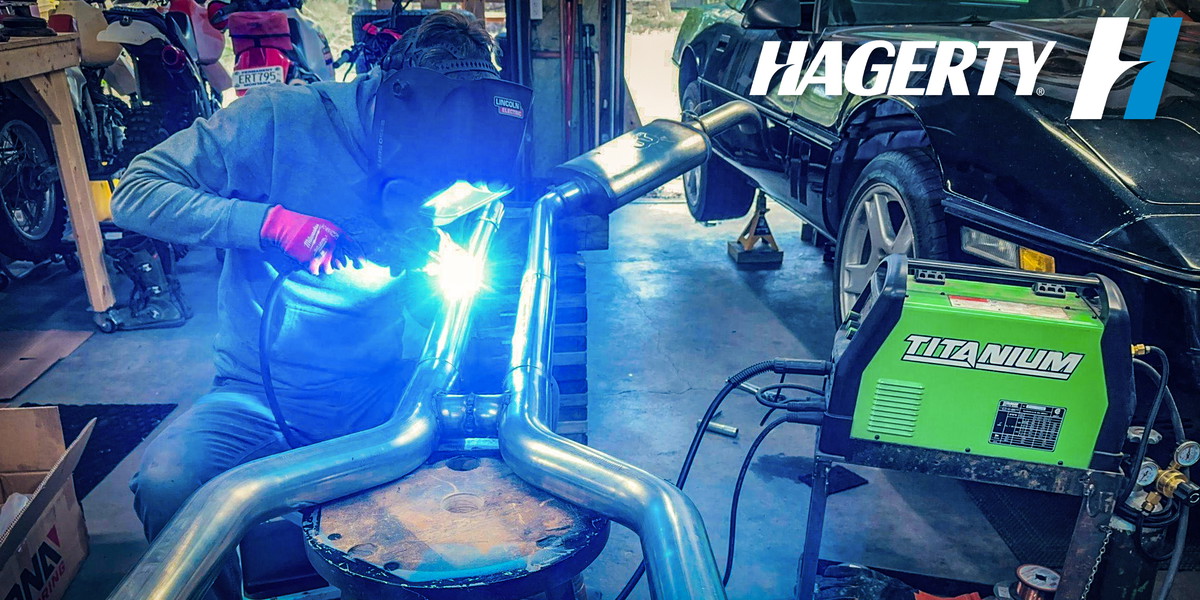
After I stated that I was about to build my own competition car exhaust system from scratch, a welder friend of mine said, “You better have good insurance for when the welds break and the exhaust falls off, hitting someone.” His statement certainly stopped me in my tracks. While I did build the exhaust myself from raw tubing and bends, I heeded his advice and chose to tack the pieces in place just enough to have a muffler shop finish the welds. All of this is why Hagerty’s recent article entitled “8 Exhaust Fabrication Tips for Your Project Car” caught my eye.
Hagerty, the Official Insurance Partner of the SCCA®, has a media arm packed full of entertaining articles that extend beyond the car insurance the company’s known for. Recently, one of those articles involved building an exhaust system.
Author Kyle Smith set the scene: “There are many systems that make cars go, stop, and get us around reliably. Exhaust is not one of those. Engines don’t really require much exhaust to function, but most drivers (and municipalities) prefer having at least something installed to knock down the noise levels to something less sonically damaging. Getting an exhaust that sounds good and is leak-free can be more complicated than just clamping a handful of tubes together under the car, but it’s still not rocket science.”
Smith went on to list eight tips and tricks to keep in mind should you choose to tackle building your own exhaust system.
“Planning makes perfect” was Smith’s first tip, and based on my own experience, it’s exceedingly true. “Having a layout you intend to build starting from step one makes the process so much easier,” he wrote. “Knowing approximately how much tubing you need and roughly what bends that might include will not only save time when you start building, but also save funds when picking the parts and pieces.”
Another tip that truly hit home was under the section entitled “Keep it simple and serviceable.” This was priority number one for me when building my own exhaust – I would prefer to lose a little bit of power if it meant I was able to drop the entire exhaust painlessly in the paddock to service a part that needed immediate attention.
Smith certainly agreed, as he wrote: “For every one of us who has cursed the name of an engineer while servicing a new car, we likely have at least one fix in our history that showed us how everyone gets shortsighted at times. The exhaust routing for my fourth-generation Corvette is kind of in the way of any future transmission or differential work, so making it easy to remove was a goal. This meant looking long and hard at the chassis to see where hanging the exhaust from made sense.”
Building the exhaust on the car, then finishing the welds off the car, are another couple of tips Smith gave that I can wholeheartedly endorse.
Read the entire article by clicking here.
If you have a fun car that could use Hagerty insurance, check out this article we wrote covering the ins and outs of some of Hagerty’s offerings.
Photo courtesy Kyle Smith / Hagerty