For the second and final time this year, Toledo would be the final destination of many East Coast autocrossers’ semi-weekly pilgrimages. And unsurprisingly, it rained.
Saturday had started off well enough, but the weather was hot and muggy – a level of hot and muggy that made some realize they needed deodorant in places they never knew existed. Certainly, heat advisories were in effect and at times the heat indexes were well over 100; the surface temperatures even higher, measured at 113 degrees. Yet unsurprisingly, it rained.
Credit for all photos: autoxpix.com/
But let’s back up a little. Half of the day on Saturday was completely dry, which produced the levels of competition one would expect. Clearing the course in heat 1 would be the vast majority of the Street category classes. FS would come out swinging, with John Laughlin in an E92 M3 and Dave Feighner in his 2015 Mustang GT taking the top two PAX spots in the heat by a significant margin. Johnny Rose – driving this writer’s former RX8 – would take a somewhat distant 3rd, but a minor lead in CS over second-place Randy Pearson. ES would prove to be a bit of an upset, as George Schmitt would take the lead over Eric Peterson in the morning, and proving the 99 Sport still has what it takes.
Heat 2 would primarily feature Street Touring cars, and John Brown from STS would prove to be the fastest of them on index in the morning. Eric Kutil led the way for STX in an Integra Type-R, by less than a tenth over Kyle Herbst in the #cheatercar #cheatertires #woowoo BMW 128i, with Herbst unfortunately stuck sitting on his first run. David Santel in his FRS – affectionately called “Caitlyn” – would trail a few tenths behind Herbst to round out the top PAX spots in the heat for the morning.
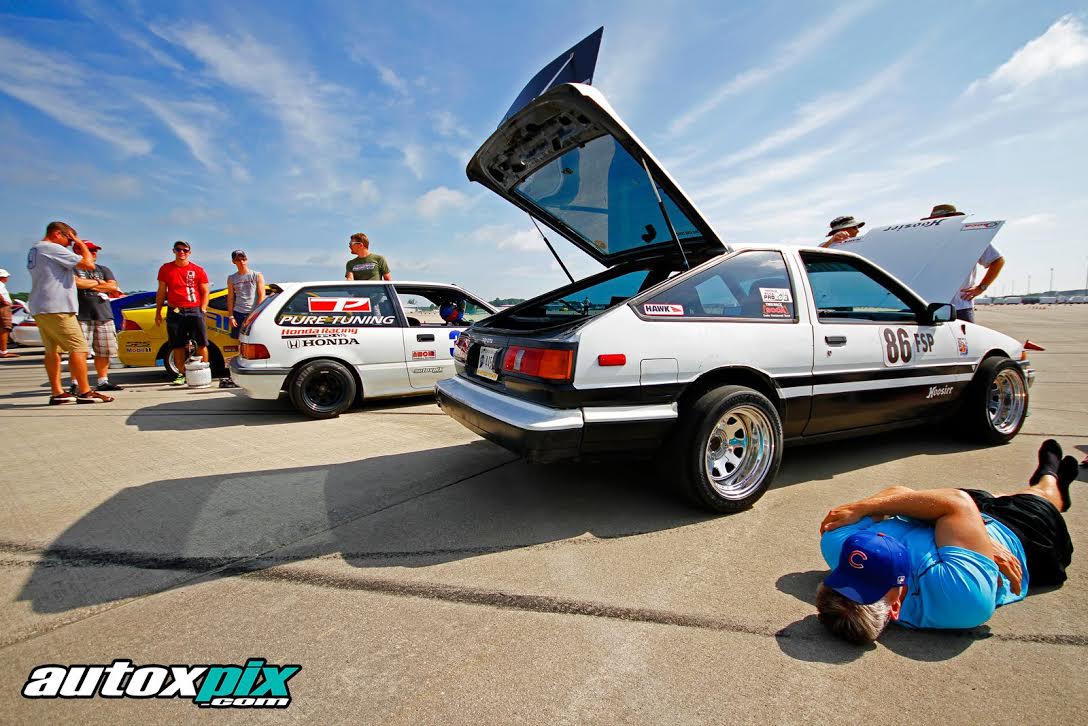
Heat 3 would be a mostly FSP affair, with Nick Myers literally bicycling his way to the top of the class and the PAX charts – both for the heat and overall. His AE86 Corolla would meet its unfortunate end on Sunday morning, but on Saturday, it was “money” (Nick’s words). Co-driver and car owner Jason West would trail in 2nd, followed by Scott Giles, Steve Mieritz, and Renee Hines – all in FSP and all names that have certainly graced these pages before in mention of some sort of winning achievement. FSP brought their A-game to Toledo and as a result, five of the top fifteen in PAX for Saturday morning of the entire event were all FSP cars. ESP and CP would fill in many of those remaining gaps.
Lastly, in heat 4, the M and P cars would come out to play. Andrew Blasiman led the heat on index and second on overall index in a DP Miata, but would retire the car by Sunday after the car developed and unknown engine noise. Typical Mod category staples such as Clemens Burger and Dan Cyr from BM, and Brandon Lavender from CM, ended up very fast as well, and were not far behind Blasiman.
As heat 4 was finishing, rain began to develop on the radar. A front was moving in from the north and it was picking up steam. By the time heat 1 had taken to the course for Saturday afternoon, rain began to fall as GS was staged at the line. Lightning had come hand-in-hand with the rain, and the event was stopped for roughly an hour. With such a huge event, the staff had to make the difficult call of cutting everyone down to two runs for the afternoon to ensure the event would finish on time. For some who threw away their only dry run with a cone – or worse, got no dry runs, it would be an uphill battle for them in the now-wet conditions.
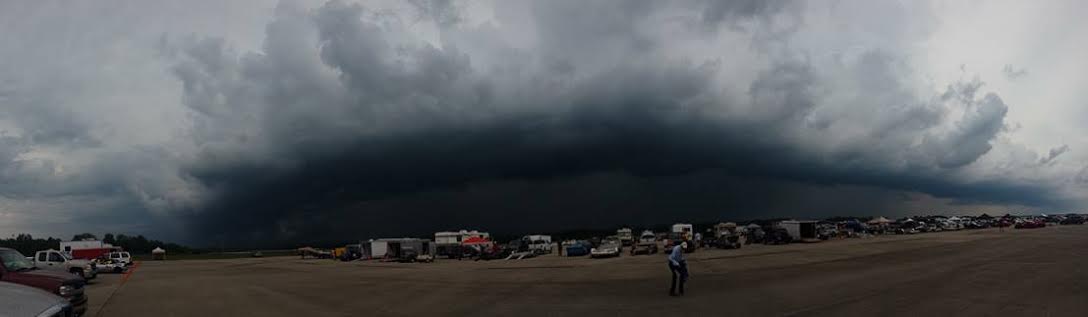
As the heats went back through their orders for second set of runs, the drying conditions after the rain stopped in heat 1 was taking its toll on drivers. Drying conditions can be one of the most frustrating aspects of autocross – it’s impossible to tell how fast the course will dry or where – and those who were unable to adapt struggled. It’s the one time where looking ahead sometimes works against you, as some of the faster drivers were reporting that they simply drove off the ends of their car, looked for the dry spots, and drove to them.
The event ended on Saturday mostly dry, but with the main event now complete, the clocks would all reset for Sunday morning as drivers completed their qualifying runs for the challenges.
Of course, the Sunday Match Tour results are never quite what they seem. Sandbagging was a common topic of conversation through the paddock, and everyone had a different take on strategy. Unlike a ProSolo, the Match Tour format is based only on your own dial-in (not a class dial-in) and there is little to no penalty for a breakout. That being said, the top qualifiers for each heat were as follows:
- Dave Feighner in heat 1 would top his deficit to Laughlin to take the top spot. Laughlin would cone a 63.9 to best his speed from Saturday, but would sit on the 63.9 – much like a ProSolo, raw times count for your dial-in.
- David Santel takes top spot in heat 2, putting his best foot forward and pretty much completely foregoing any sandbag strategy.
- Nick Myers would scream back to the top again, proving Saturday was no fluke in the mighty AE86, but it didn’t remain mighty for long – unfortunately, the bottom end decided to step out for fresh air on Jason West’s last run, ending any possibility of Myers moving on to a challenge.
- Dan Cyr, also not keen on sandbagging, would take a 1.3 second lead over the rest of heat 4 on his final run.
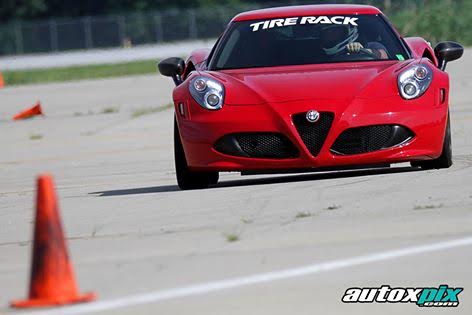
Moving on to the challenges, we start with the Pro Challenge, which was comprised of folks who were top 8 on index in their respective heats. Each heat winner would throw down one last run to take the win. This final round consisted of Danny Kao in the DS Cookie Monster, Allen Chen from BS, Ryan Finch from ESP (whose Camaro had earlier lost a hub while exiting the course, and had jumped into Jeff Cox’s GT500 at the last minute – top-notch sportsmanship there), and Brandon Lavender from CM. Most of the drivers had broken out significantly enough by then to still be chasing their new dial-ins, but Allen Chen would emerge the winner as the only driver of the four to improve.
The Bonus Challenge is smaller, consisting of people who had been drawn at random to compete, just like the ProSolo Bonus Challenge. This challenge came down to two number 35 cars – John Souder from CS and Christopher Bickford from ASP – and much like Thunderdome, only one of them would leave. This would turn out to be Bickford, coming in with a slight breakout to take the win.
Last for the event is the Club Shootout, which intends to highlight some of the faster regional drivers, focusing on the 8th-16th positions in each heat. Just like the Pro challenge, this whittled its way down to four competitors – local Tim Carritte from HS, Mark Stevens in STX, Michael Nienhuis from ESP, and Ray Thomas from CM. Thomas would go on to be the winner, again by virtue of a breakout. Mark Stevens had also broken out in this round, but it would not be by enough to top Thomas’ improvement.
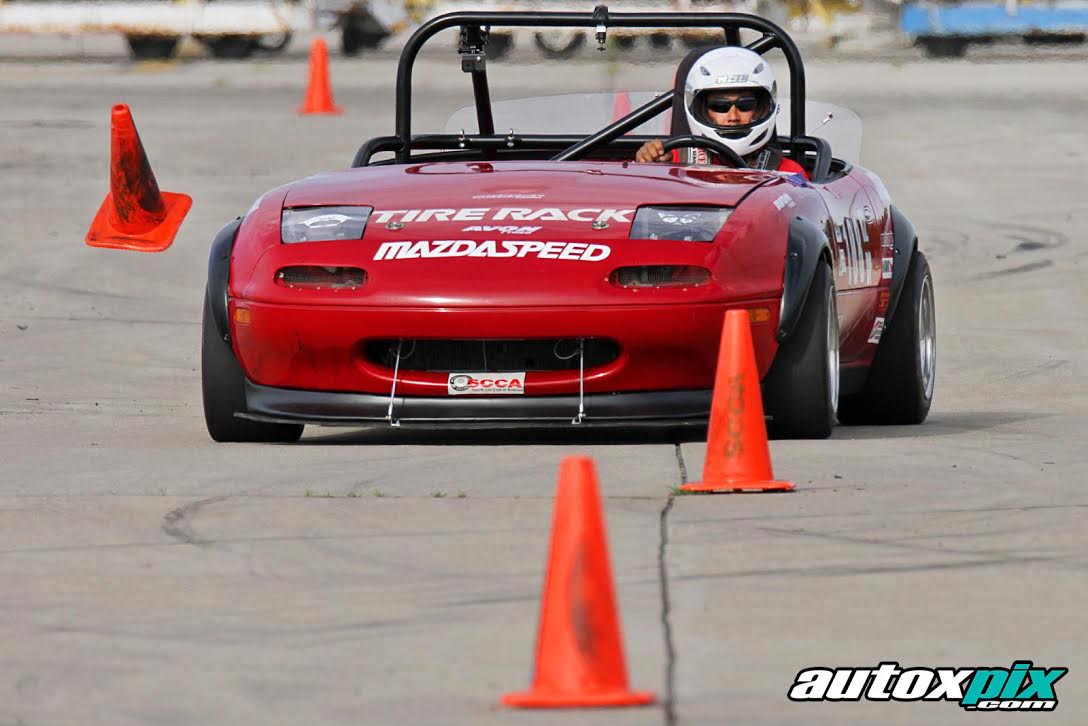
That would conclude the 2015 Match Tour season. The format was greatly improved this year and has been an increasingly popular series of events. Look for more of them from Brian Harmer and crew next year!
The cars are packed up, the trailers are loaded, the hand shakes and hugs are exchanged, and a lot of “See you at Nationals”told to one another. While some take their last breath of mountain fresh air before heading back to city life Monday, others embark on the long drive home. This marks the end of the Packwood ProSolo, and two weekends of fun in a mountain paradise. Once again we were graced with cloudless skies, hot pavement and were able to enjoyed the wonderful indoor grid and paddock. The courses were very fast and had horsepower digs, but had sections that require some brass “you know whats” to believe in the grip and go in hard. Those who trusted their car and set the line up right were rewarded with fast times. Those who reacted too late ended up wide, or even in a spin. It took a lot to put together a complete run even on this shorter course.
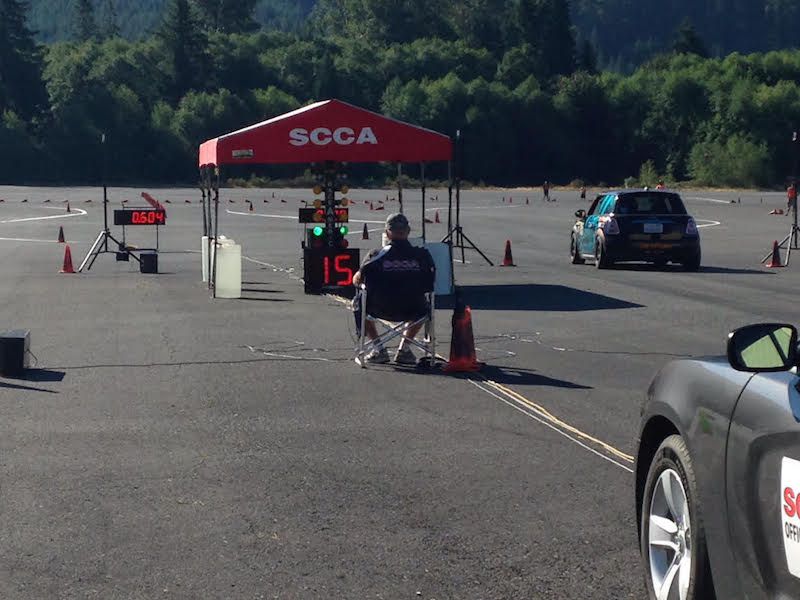
Enjoying some of the cool morning, L1’s top drivers took advantage of their power and AWD to get the most out of Sunday runs. Laurie Hyman in the GTR carried a sizable 8/10 lead after day 1, but wasn’t satisfied with that in the least. After heating up the tires on her first two runs, she went on to put down a 23.082 on the left, and a smoking 22.927 on the right putting her with only a handful of cars with doors who were able to find the 22’s this weekend. Jodi Fordahl and Event Chair Caitlin Snell were both able to find time on the left dropping into the mid 23’s, but neither was able to find a fast enough right side to displace Hyman. Laurie would take a 8/10 win over Fordahl with Snell just 2/10 back from there. L2 was a much closer battle with Jami Olerich on her final left side run finding almost 1 full second to jump to a .250 lead over Laura Molleker and Barbara LeRoy-Boehme. If Sunday runs in L3 had to be an element of a movie, it would be the plot twist! Tasha Mikko in her STU Evo held a lead in the class after the first session over Mina Ingraham in the 2004 STi. Mikko would go on to drop time during the afternoon runs to extend that lead even further. Little did we know the beast of a Subaru was soon to be unleashed on the course Sunday. Ingraham came out and dropped an immediate 1 second on the left side. On the final two runs, both drivers found the 24.8 mark on the right side, but on her final run, Ingraham found another 4/10 on the left to take a .418 win over Mikko and the rest of the class.
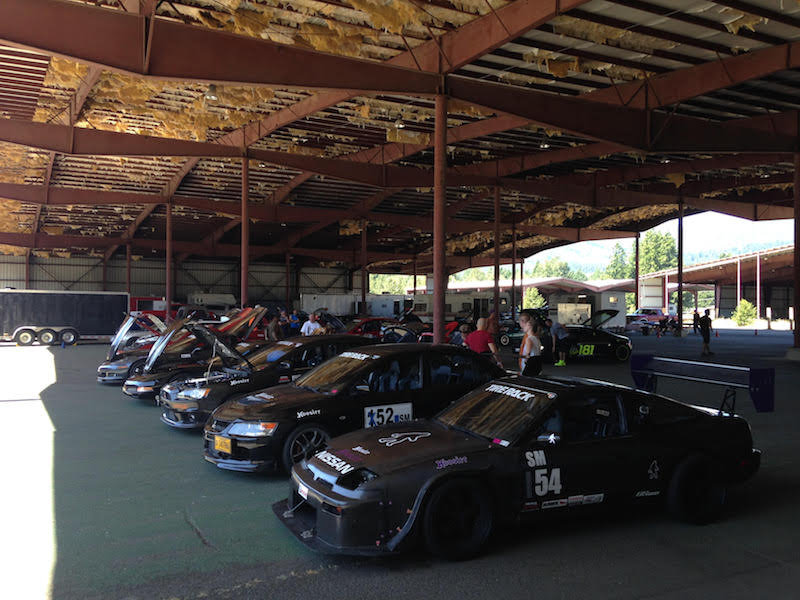
In SM, Dallas Cutler in the 2006 Mitsubishi Evo would get his revenge for last weekend by finding 6/10 of a second on his final left side, and 7/10 on his final right side to take a large .760 lead over Jason Merritt in the 1989 240SX. SSM Leader after day 1 David de Regt driving the 2006 Lotus Elise had a slim margin over Eric Hyman in the Nissan GTR after 8 runs. Both drivers sitting in the high 22’s. Both drivers found time right away Sunday with Hyman dropping .1 on his best left, and de Regt finding .090 on this right to maintain the lead. In the final two runs, de Regt was unable to find any time. Hyman shaved another 2/10 on the right, but coned his left side that would have given him the win. de Regt would take a thinnest .039 win over the Godzilla GTR.
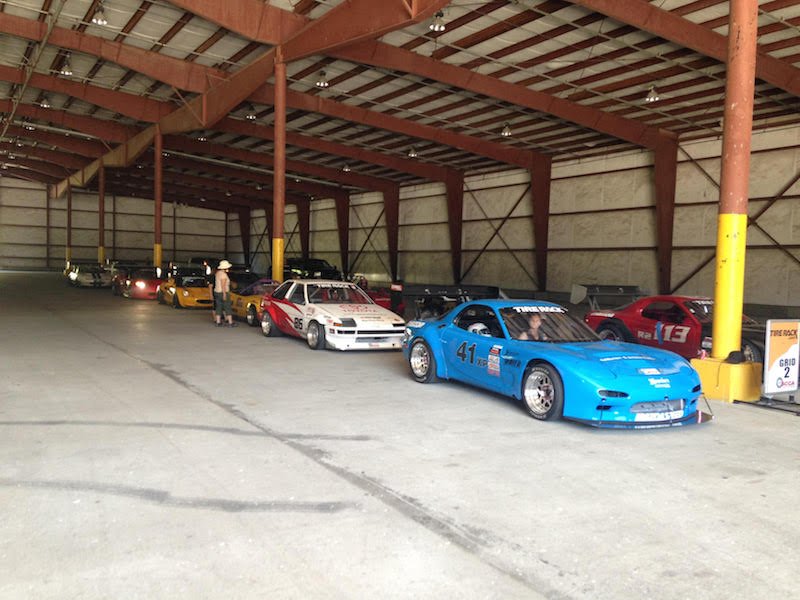
Staying with the theme of race tires, R1 was the land of no-door vehicles with Eric Clements in the 1994 Van Diemen C-Mod car fighting for the lead with Glen Barnhouse in the 2010 Dig It F-Mod. Barnhouse figured the course out quickly and was able to run high 22’s in just the first session on Saturday. Clements would spend the rest of the weekend chasing him. The C-Mod driver was able to drop time both sides on Sunday, but it wouldn’t be enough to overtake the F-mod. Barnhouse would take home a .365 second win resting on his Saturday runs over Eric Clements and son Jonathan Clements rounding out the trophies. R2 Sunday runs would finish the battle between Chris Dorsey in D-Prepared Corolla vs high power Andy McKee in the X-Prepared RX-7. McKee had the lead after day 1 on a pair of 22.7 runs, but was unable to stay clean Sunday afternoon. Chris Dorsey on the other hand was able to find 2/10 on the left side, and a full 8/10 on the right to jump back into the lead and take a .449 win over McKee. KP in the 1998 Lotus Elise would take 3rd .377 back from Mckee, and Ron Baker in the 4th and final trophy spot. If there was ever a well stacked R2 class, this was it.
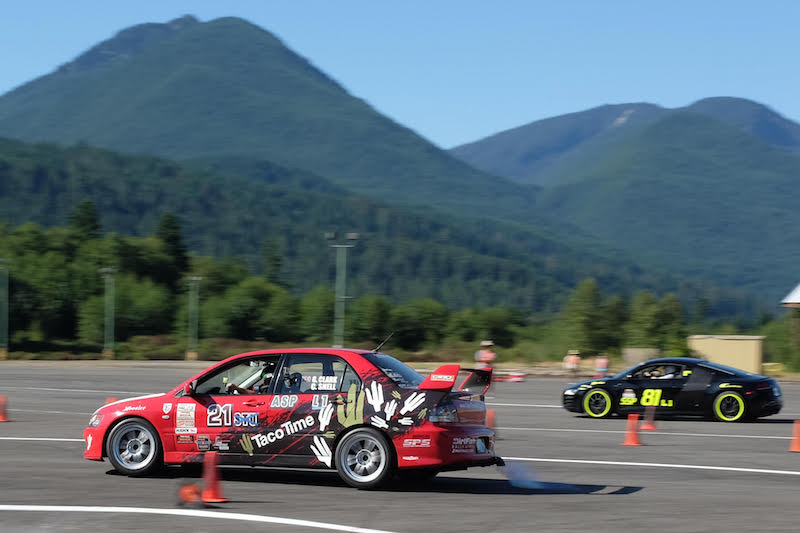
If you’re wondering how the Coleman/Spyksma show that I talked about on the Saturday recap ended, there was a surprise special guest of Chris Thorpe in the 2012 VW Golf R, dropping an impressive 6/10 to on the left and 1/10 on the right to move him into the 2nd and final trophy position bumping Charly Spyksma out. Karl Coleman was able to find 5/10 per side on Sunday putting down a pair of 24.5’s to take a 9/10 win over the class in the 2015 Subaru WRX.
With the closing of the gates at Hamptom Mills in Packwood Washington, this means we are completed with our last West coast ProSolo for the season. Tune in in 2 weeks to our final round of the Tire Rack ProSolo series in Wilmington Ohio.
It calls to all with gasoline in their veins: You and your car, an hour of track time during a 4 p.m. to 8 p.m. window, on a weeknight — all for just $150. And rulebooks? They don’t exist. Run what ya brung, have a blast, repeat. It’s a winning formula. At least, that’s what SCCA’s latest program is gambling on.
SCCA’s Track Night in America driven by Tire Rack offers low-buck, convenient track time, luring enthusiasts into the SCCA fold with low-stress,  low-commitment, easily accessible time on the race track in just about any street car. But this isn’t just another day at the track.
Track Night’s journey from concept to reality was not a short one, explains SCCA’s Director of Experiential Programs, Heyward Wagner: “The idea was born in SCCA’s marketing department about five years ago,” he says. “At that time, we didn’t have a department to execute a program of this scale. When the Experiential department was created last spring, Track Night was one of the very first ideas that was brought to us, and we loved it.”
The first Track Night took place April 6, 2015 — one year and six days after Wagner’s department was formed — and was made possible in large part thanks to a grant from the FIA and sponsorship from longtime SCCA partner Tire Rack.
What’s different about Track Night? For starters, unlike almost every other track day, Track Night takes place during weekday evenings, usually Tuesdays or Thursdays, with a sticker price of $150 (less if you search online for a discount code). Track Night also encourages spectators, offers free parade laps halfway through the event, and welcomes groups — like SCCA Regions, local scouts, and so on — to host gatherings at the track for free. At most venues, Track Night will occur the same time each month for several consecutive months.
“The program is designed to be fun, easy and accessible for seasoned veterans and rookies,” says Wagner. Hosting the events on weekdays means that enthusiasts who are hyper-scheduled on weekends can break away from work a little early to hit the track.
“The target demographic is people who want to have fun with cars,” he continues, noting that Track Night is primarily designed to attract race track novices. “We would love to see Track Night as a tool to introduce SCCA to people who may not have been involved before. And, so far, we have been successful with this, as 57 percent of our first 1,000 entrants were not previously members.” Of those, 42 percent were also less than 35 years old.
Around 80 SCCA Track Nights are slated to take place during 2015, with the program continuing into 2016.
 “The FIA grant is only for 2015, but we are committed to the program in 2016 and beyond,” says Wagner. “We would like to see an increase in events by 20 each year. That will likely include events in the off-season at some venues, as well as adding new tracks.”
PREPARE FOR ACTION
The schedule of an average Track Night has participants arriving at the track between 3 p.m. and 4 p.m., and being on the track soon thereafter. There are waivers and tech sheets, but that’s a simple process that the Track Night staff assists with.
There are some other things to know before heading to the track, however. Bring long pants, closed-toe shoes, and a hat, sunscreen and water. Some tracks allow you to run in short sleeves while others mandate long sleeves — we’d recommend the latter. You’ll also need a helmet with at least a Snell SA2000, M2000, K2005, K98, or FIA 8860-2005 rating. Should you not have a helmet, one can be purchased during Track Night’s online registration at http://www.TrackNightInAmerica.com.
Your vehicle will also need attention. “Clean out all the miscellaneous junk in your car at home,” advises West Coast Track Night Event Manager Eric Clements. From there, check all fluids, brake pads, and torque the lug nuts. “Less than two-year-old brake fluid is good — and if you’re not mechanically savvy, it’s a good idea to get a cheap or free multi-point inspection.”
Words by Philip Royle for RACER