Ask anyone how to log faster laps around a track, and the short answer will be “seat time.” The problem is, seat time is only as good as the laps you’re putting in. Keep making the same mistake time and time again, and those errors will compound and become second nature – before you know it, you’re learning the wrong line, the wrong entry techniques, and you’re getting on the gas too late. One solution is data analysis via one-on-one driver coaching. Another solution, says Fire Laps, is data analysis using machine learning.
A new SCCA® partner offering Club members a free software preview plus a discount on its hardware (not to mention this limited-time holiday offer that jumpstarts new members into the product’s offerings that also works with the SCCA discount), Fire Laps takes data from the company’s data box or an AiM system and uses AI to analyze your laps to determine not only an optimal driving line, but also what inputs the driver should be making vs. what the data shows is actually happening.
“Fire Laps is the world’s first and only driver development platform,” says Fire Laps CEO and co-founder David Calzada. “It uses your motorsports data, whether it’s from an AiM device or our own data logger, and it analyzes that data and compares it to other community-sourced data from our database of thousands and thousands of laps, then it provides you with specific insights where you can find time to go faster.”
Keeping It Simple
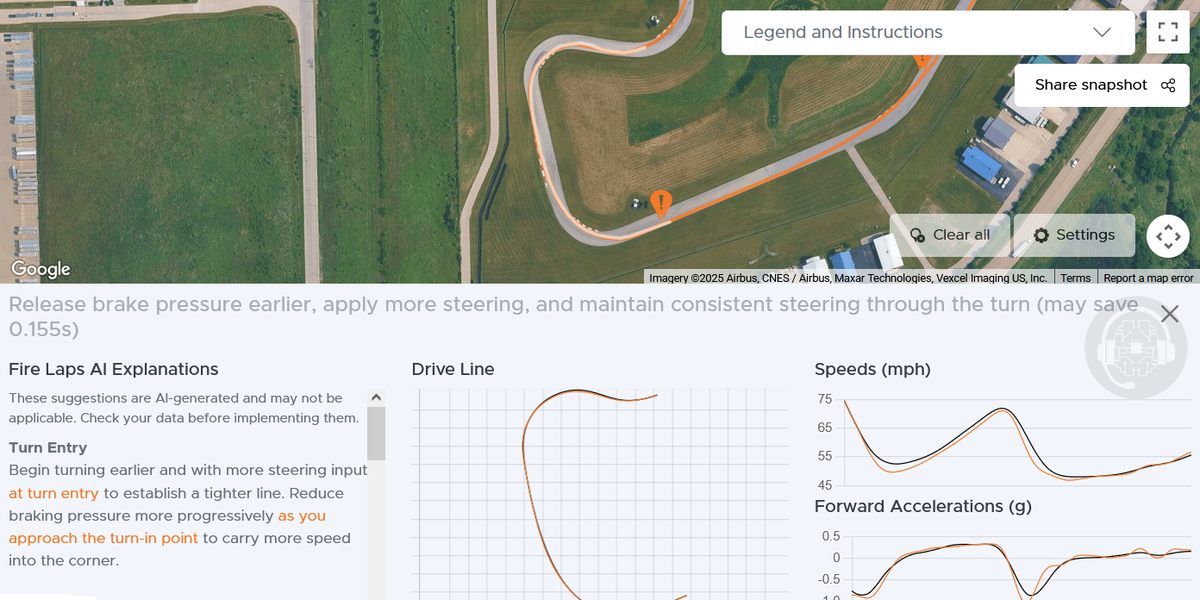
With your data uploaded to Fire Laps, users are presented with a variety of options via the web interface. While all of the data is present, the goal of Fire Laps is to put it in a format that isn’t overwhelming.
“Instead of looking at graphs and trying to figure out where you can find time, Fire Laps will show you a nice clean view easy enough for my 10-year-old go-karter to use, and Fire Laps will say, turn later here or brake less, and it may say to brake later to save 0.2 seconds,” David says. “That’s the kind of insights that you get.”
Where Fire Laps truly differs from other data systems, however, is in the data it has access to.
It Takes a Village
“Fire Laps is drawing from an entire database of thousands and thousands of laps; it’s looking at your driver, your vehicle, and it’s pulling parity between other similar vehicles and similar levels of grip,” David explains. “It’s able to give you insight maybe beyond what you did that last session, because it’s looking at the global data and giving you insights from that.”
Combining your data and data from other racers uploaded to Fire Laps, the system then analyzes your lap and offers suggestions. “It uses machine learning to analyze your laps based on your data and other data you otherwise wouldn’t have access to – and it does it fast,” he says. “Fire Laps has a superhuman ability to analyze all of this data amazingly quickly.”
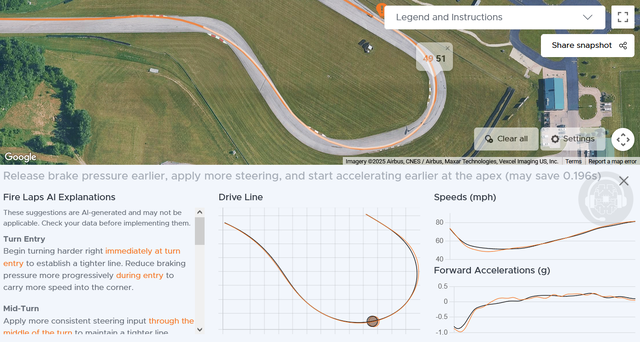
(The Fire Laps interface quickly offers drivers input while also presenting the data to back up the claims.)
According to David, Fire Laps has a database of tens of thousands of laps that were uploaded by its users over the last three and a half years, but it wasn’t always that way. “When we launched, we had a small, minimally viable product,” David says of the early days of Fire Laps. “We offered some insights to drivers, and we kept scaling the product. We worked with early adopters to get as much data as we could.”
In those days, Fire Laps required all users to gather data using an AiM data system, then upload it to Fire Laps. While users can still opt to manually upload their data, the process can be automatic via the company’s optional hardware.
“What’s really neat is we have our own hardware, designed to be the backbone of the data analysis,” David says. “It’s called the Fire Link. It’s a little aluminum box that has a GPS antenna and a 4G antenna. When you drive, your data is uploaded to our platform. Instead of requiring users to connect to their data system and pull that data off and maybe or maybe not upload it to the platform, the Fire Link does that automatically and puts insights in your online dashboard. Then you can click the link.”
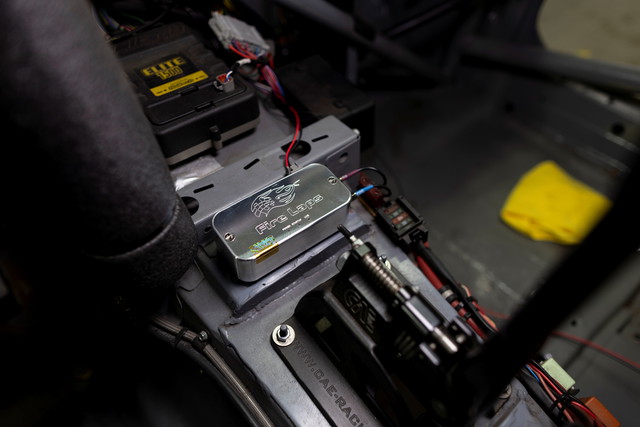
(The Fire Laps Fire Link hardware pairs easy installation with 4G connectivity that automatically uploads data, meaning post-session data analysis requires little more than launching a web browser or opening the app.)
Whether uploaded manually or automatically via the Fire Link, the data that’s uploaded can be as public or as private as you’d like.
“There are privacy settings,” David adds. “You can choose to share your data with everyone, you can choose to share your data with no one, or you can share it with only your groups and events that are relevant.”
Interpreting Data
While Fire Laps is primarily about machine learning, there’s a community element. “I can create a group, almost like a Facebook group, where I can share my data with friends,” says David. “You can set it up however you like. A lot of coaches have set it up where their clients have a Fire Link and their data gets sent over to them automatically and the coach can analyze it and share feedback with them.”
Data means nothing without interpretation, and while Fire Laps can be used like a traditional data system with the driver or a coach wading through graphs, the magic of Fire Laps lies in machine learning.
“It’s kind of a two-step process,” Fire Laps Chief Technical Officer and co-founder Daniel Calzada explains of what the Fire Laps software is doing behind the scenes. “One part is, given the lap, how do you find the best line and the best speeds; the next step is, given the optimal line, how do you turn that into English.
“In order to find the optimal line, we look at the g forces and the speeds you did in that session, the locations that you drove – the lines that you took – and we kind of blend those into an optimal line. As we’re doing that, we’re checking that the line that we recommend stays within the lateral Gs and acceleration you met in that session.”
The second part, he says, is converting all of that into English. At the same time, the raw data is present for those wanting to look for themselves.
“We show you the text and we show you the actual graphs of speed and accelerations, so you can cross check the text to make sure the description of what to do is realistic, the lines stay on track, and it’s within the range of what your vehicle can do,” Daniel says. “As you do that, we’ve found that users rely on the prompts more and more because the Fire Laps descriptions are so accurate.”
Data Data Data
Obtaining useful data is more complex than capturing information from an accelerometer and GPS beacon. Rain, sun, clouds, temperature – everything can affect a vehicle’s performance. Traditionally, a driver would note all of that. While Fire Laps can’t automatically log everything, it does gather much of the external data that proves useful.
“With all data logs, we have access to a date and time, and we automatically pull the weather, so we know the weather conditions and factor this into our analysis,” Daniel explains.
The platform then allows drivers to add in other data that the system could not otherwise know.
“There’s a garage where you can have as many cars as you want,” says David. “There’s a place to put your tires, your tire pressures, your class. Then you can get into suspension notes, like shock settings, etcetera.”
Fire Laps can then pull from a driver’s notes to build data profiles that are usable for other users.
“We have data on similar tires, and the more data we get, the more we can continue to build out the platform, so as people put those notes in, there’s more value to everyone. Even if it’s private only to you, we can still use it in our model,” David says.
User-inputted notes are a useful piece of the data comparison puzzle, but the Fire Laps software is careful to take notes with a grain of salt. The software weighs the importance of data it can confirm over anything that may introduce errors from the user.
Speaking of public and private data, Fire Link users can opt to stream their data live, since all of this is automatically uploaded via Fire Link’s 4G connection.
A Holistic Look at Data
“A lot of data systems will try to supersize your laps and take your best Turn 1 from this lap and the best straight from this lap, but that’s not how driving works,” Daniel notes. “We treat the whole thing as one holistic picture.”
“We have a feature called ‘My Fire Laps,’ and what it’s doing is looking at your data and it’s giving you areas to improve,” explains David. “Based on your actual session, it will create an AI-generated lap, but it’s making a real data file out of it, where as ‘theoretical fast laps’ from other data systems tend to chop data from laps. With Fire Laps, you can actually overlay our fast lap file and it will tell – and show – you what you need to do to get to that fast lap.”
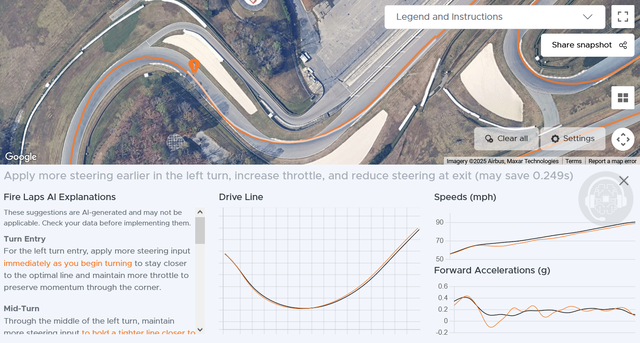
(Analysis and suggestions presented by Fire Laps come not only from your data, but also data from drivers in vehicles with similar capabilities who also use Fire Laps.)
It's notable that as Fire Laps builds a data-generated fast lap, it creates something that is attainable for the driver. “It’s only going to push you so far,” David says. “We only let it go a certain percentage ahead of your actual pace. We don’t want to tell a new driver they can go 15 seconds faster per lap.”
Is This for Me?
David and Daniel are quick to point out that Fire Laps may not be for everyone.
“We look at this as a tool for 80% of the paddock,” David admits. “We didn’t build this for the super data nerd who digs into every graph and overlay. This is a tool for someone who might find data confusing but wants a tool that tells them how to make time. Fire Laps makes data accessible to the majority of people.”
Speed in accessing the data, along with knowing what to work on during the next session, is key.
“It’s about the time savings, and it’s about being at a new track – it’ll be 10 minutes before I’m on track, and I’ll look at my phone real quick and look at my three best opportunities from my last race,” David says. “Everything else out there records your data. AiM does a great job recording your data. But it’s up to you to sift through it, and you can spend hours doing that. What we do is make it the fastest way to get faster because you don’t need to spend all day going through the data; you need five minutes – we can help all of that by using machine learning to do it quicker than any individual can.”
Fire Laps offers a variety of data analysis plans that work with or without the company’s Fire Link hardware. There are a couple monthly and yearly plans, as well as a weekend pass that lets you try out many of the features.
Furthermore, SCCA members receive six months of free Intelligent Lap Coach access and 10% off the Fire Link device. This comes in addition to the Fire Link 100 lap guarantee, where if you don’t find time on track within your first 100 days, you can return the Fire Link for a full refund. Fire Laps will even pay for the return shipping.