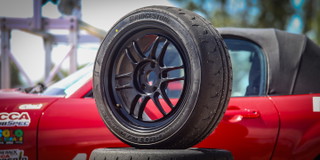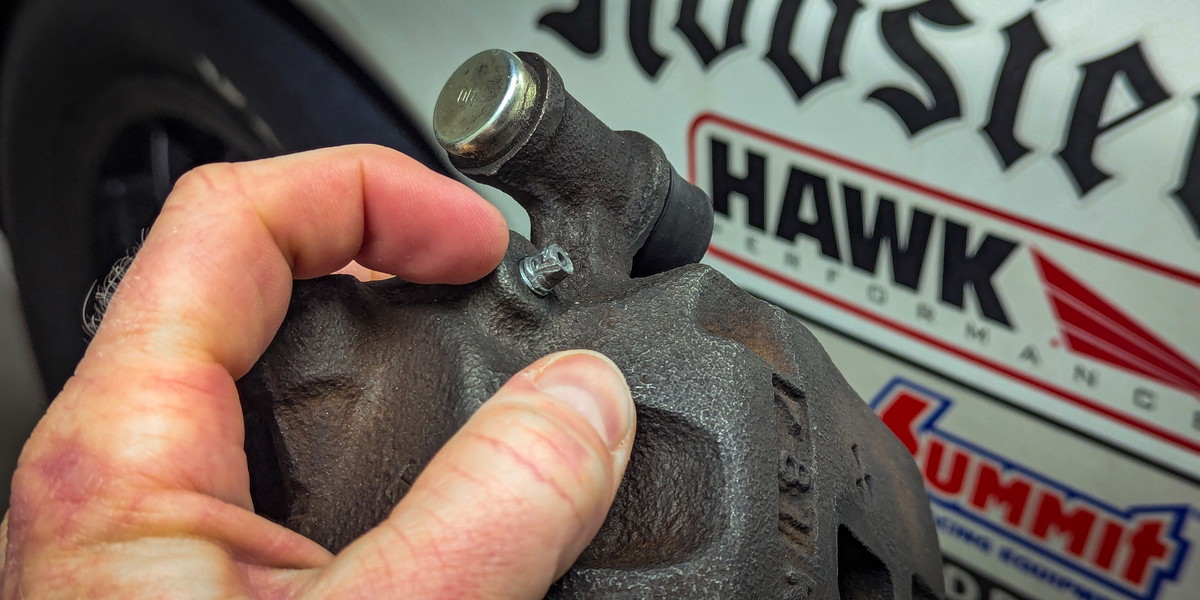
While I didn’t stop competing at SCCA® events, my dedicated race car sure took a hiatus. My E Production Mazda was raced in 2019, then underwent the knife for a major overhaul in early 2020. Covid happened, life happened, inspiration dried up, and the next thing you know, it’s late 2024 and I’m barely picking up the tools. A few months later, a new transmission tunnel had been welded in, the car’s interior had been repainted, and the entire chassis had been rewired (successfully!). All that remained was easy-peasy general maintenance. Tackling a routine brake bleed that should have taken less than an hour, a bleeder screw snapped in the caliper (the car’s 2019 race was in the rain, so possibly a side effect of that), and I was suddenly facing disaster.
That’s a bit of hyperbole. Still, it was annoying.
While I ordered and installed a new brake caliper without issue, I also realized I could no longer trust any of the fluid in the brake system.
When I’m actively racing, I’m up on my car’s maintenance, which means I use quite a bit of brake fluid. How much? A lot of my knowledge comes from Hawk Performance’s FAQ. The Official Brake Products of the SCCA since 2019, Hawk’s website has long been my go-to for stopping-related questions.
How often should brake fluid be bled on a track car? “Be sure to bleed after every event to get clear fluid at the caliper, and then top off [the] reservoir,” Hawk’s FAQ says. I take that one step further and check the fluid after every session, sometimes bleeding a caliper’s worth of fluid from all four corners following each day of competition.
How often should the entire brake system be bled? “For track day usage, fluid should be replaced every season,” notes Hawk’s FAQ. Because I live in a part of the country where we race year-round, I tend not to flush the entire system at once – in my mind, multiple short brake bleeding sessions throughout the season keeps things fresh in my low humidity climate.
What I was facing with this stuck brake bleeder valve was different, however. The bleeder valve likely got stuck due to corrosion from the last race, meaning water potentially penetrated deep into the bleeder screw threads, corrupting the entire system. This made me especially nervous because I use DOT 4 brake fluid, and as Hawk’s FAQ notes: “Dot 4 has higher boiling temperatures but needs to be changed more often due to water absorption properties.”
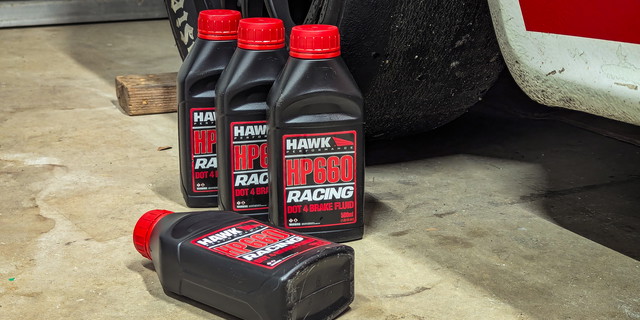
Since Hawk offers SCCA members a discount coupon when they join or renew their membership to the Sports Car Club of America™, my only real decision when ordering new brake fluid was whether I’d order Hawk’s HP600 or HP660 brake fluid to flush the entire system.
Both HP600 and HP660 are DOT 4 fluids, meaning they’re compatible with other glycol-based brake fluids like DOT 3, 4, and 5.1 (although Hawk recommends only mixing DOT fluids in an emergency). Hawk also notes: “DOT 5 is a specialty silicon based fluid and not compatible with any other brake fluid.”
The specs for Hawk’s brake fluids can be found here, but the long and short of it is HP600 offers a dry boiling point of 572°F and a wet boiling point of 383°F. HP660 has a dry boiling point of 608°F and 383°F wet.
The question then became, which fluid do I order when flushing my Mazda’s entire brake system?
A smarter person would have previously logged their brake temps through temperature-indicating paint, a temperature adhesive strip, or via a pyrometer. Having never monitored my own race car’s brake temperatures before, I ordered HP660 – the price difference was only $5 per bottle, which was well worth the peace of mind of getting the higher boiling point.
Good news! My race car is up and running, and its first weekend back at a Summit Racing Equipment SCCA Road Racing Series event was more than successful – and rainy. Braking was never an issue, but being that (much like the car’s 2019 race) this event was wet during both days of competition, it looks like I’ll be bleeding the car’s brake fluid thoroughly once more. And sooner rather than later.
Potential disaster was averted thanks to a little knowledge. Thanks Hawk!
More information about Hawk Performance, the company’s performance brake pads, and its HP600 and HP660 brake fluid, can be found on Hawk’s website.
Photo by Philip Royle