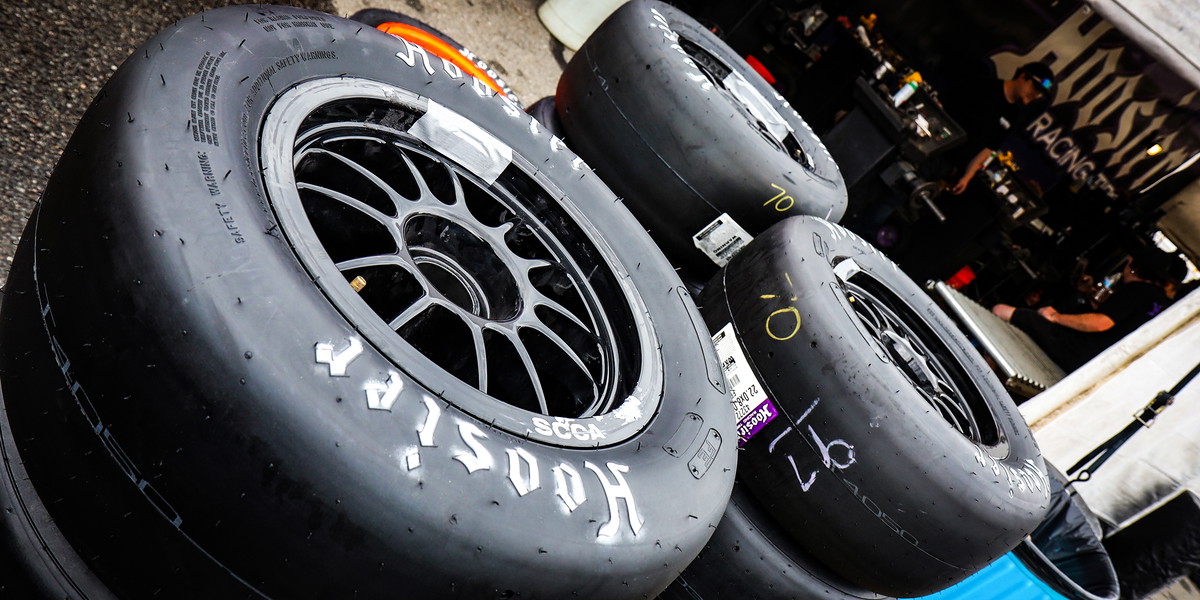
I’ll admit it – I’m a broken record when it comes to tires. “Tires are everything!” I can’t stop saying it in the articles I write (kinda like this one). Obviously, I’m obsessed with tires, because (again, broken record) tires are everything.
Tires are the only thing between your race car and the track surface, which means every single action (acceleration, steering, braking, and the feel of the car) is done through those black round expensive rubber donuts. So, if your tires suck, your car’s performance will suck, too. If your tires are too hot, the wrong pressure, worn down to the cords, or you’re using slicks in the rain, your ability to be quick on the track will be diminished.
In order to ensure your tires are working optimally (which will make you faster and safer) you really need to pay attention to the details when it comes to tires.
Like you, I’m not made of money, and tires aren’t cheap, which means I have to make decisions about tires during a race weekend that are not based solely on performance but on my limited budget. For a road racing weekend, I try to bring as many tires as possible, but I don’t always have enough extra Benjamins to have a qualifying set, a race set, and then a rain set sitting in the wings.
Because I don’t have all of the tires, that means I have to manage my tire resources accordingly. Here are five ways to manage your tires during a race, a race weekend, or over a season.
1. Temperature
Have I mentioned that tires are everything? Along those lines, tire temperature is also everything. Cold tires don’t grip as well as optimally warm tires do, and heat-soaked tires (over saturated) become greasy and don’t grip as well as tires just a few degrees cooler. All of this is to say that the secret to speed is having tires that are the perfect temperature. How do we do that?
When you’re in a 30-45 minute sprint race, you want your tires to be in the optimal heat range for as long as possible. First, you’ll heat them up during the warm-up lap so your tires are sticky for the all-important first turn and first lap. Then as the race progresses, if you go really hard, using the tires aggressively, you may saturate your tires making them too hot and less grippy.
Smart drivers manage their tires based on the length of the race and when they need to fight for position, keeping their tires at their best temperature. If you get a good start and can stretch out a bit of a lead, you can roll things back and cool the tires a bit to save them for the end of the race. If you find yourself battling hard for position early in the race, you may find you’re using too much of the tires (overheating them) and you won’t have much left for the end of the race. Choose wisely.
The trick is to use your brain and not just your right foot to create a strategy, and think about the race length as a full package. When are you going to “turn on the juice” and use the tires to their maximum ability, and when are you going to cool things down a bit?
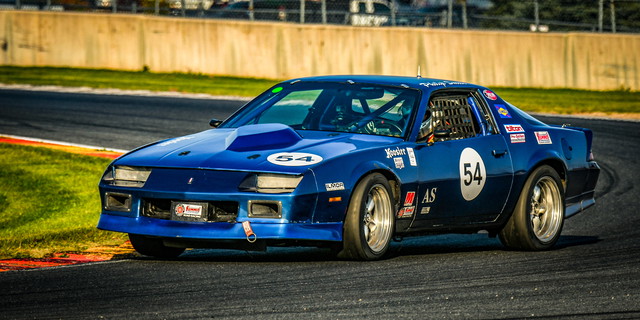
(Tires don't offer unlimited grip. As the race wears on, tires tend to heat up and can become slippery. Photo by Jay Bonvouloir.)
Tires can be cooled in a couple of laps and brought back to optimal temperature for when you need them at their best. Sure, it would be great if we could just drive like maniacs the entire time and the tires would be the perfect temperature from green to checker, but thermodynamics says otherwise.
While on track, this information comes to you through the steering wheel and the seat of your pants. You’ll feel the car loosen up when things get too hot, and that’s when you need to change your driving behavior to not exacerbate the heat situation.
In short: Drivers who can battle in the last few laps for the win are the drivers who manage the heat in their tires the best.
2. Tracking
Tires don’t last forever. Well before they’re worn to the cords, they generally lose their ability to remain really sticky. This is due to hardening of the rubber after a number of heat cycles (times the tire was heated to optimal temperature or beyond, then cooled). I have certainly had tires that still looked healthy but were absolute rocks on the car.
To combat this, I track the life of my tires. I do this for road racing, autocross, and RallyCross. Once I mount up a set, I number each of my tires: LF7, RF7, RR7, LR7 (for example) with a paint pen. Then I put that data into one of my many nerdy spreadsheets. My spreadsheet has the DOT born-on date, the date I mounted the tires, and then it tracks the position of the tire on the car and the number of runs or heat cycles the tire has endured.
My method is overly complex, but it works well for my brain. An autocrosser friend of mine uses a paint pen to mark the sidewall of his tires after each run to track the total number of runs the tires have. That method works too.
The point is, find a method that will enable you to consistently track your tire usage so you can pick the right tire for the next event.
3. Inspection
After every session, my car goes on jack stands for inspection and cleaning. At the same time, I wipe down my wheels while rotating (and inspecting) the tires. The inspection involves looking for damage, foreign objects, flat spots, uneven wear, cords, chunking, and bluing (a sign of overheating).
Tire pressure is also part of the inspection.
Tire pressures are checked prior to going on track (cold temperature) and then immediately after coming off the track (hot temperature). I also gather pyrometer data (tire temps) across three measurements of the tire (outside, middle, and inside). All of this is added to my spreadsheet.
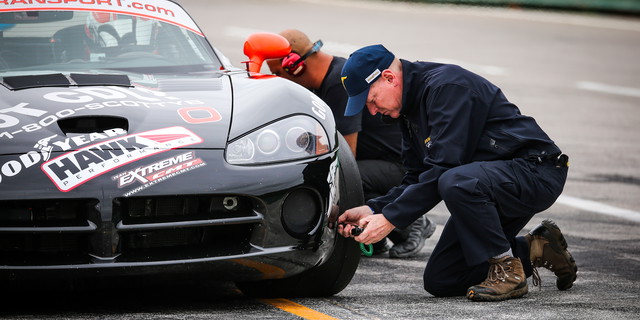
(Tire temps can reveal a lot about a car's setup.)
The data gathered from an inspection can provide crucial information about alignment changes (for example, if the tire temperature on the outside of the tire is much hotter than the middle and the inside then additional negative camber should be added).
Before any big event, I spend time examining all of the tires in my arsenal to decide which are the four best tires for success. This could be referred to as being a “tire whisperer.” But this isn’t magic; it’s actually scientific method based on the data gathered from inspecting tires.
4. Rotating or Swapping
Rotating tires from front-to-back can help lengthen the life of a tire. This works great for cars that use the same tire size on all four corners (sorry Corvette and Porshe owners), but even for vehicles where front-to-back rotation is an option, remember that it isn’t always optimal for the best grip.
You see, once a tire is mounted on a wheel and placed on a car, there is a wearing-in process – a graining of the tire based on its position. A front tire may be grained in with a certain amount of camber that you may not want to run on the rear of a fixed-axle vehicle that has little to no camber. Eventually, the tire that has been moved to the back will grain in and wear to its new position, but during that process, the contact patch may be diminished.
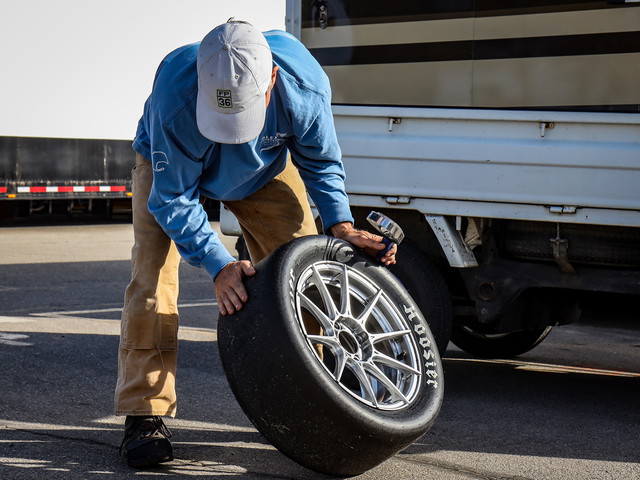
(There's a lot to consider when rotating tires. While thinking about those things, also take a moment to inspect the tire for any abnormal wear or damage.)
This is where resource management matters.
Do you want the tire to last longer so you can attend another event? Or do you want the best tire in the best possible position so you can win the race? Maybe you just want to swap in a sticker set, heat cycle and grain them in during one warm-up session, then have them ready for the big fight.
In racing, it all comes down to money, how fast can you afford to go?
5. Back Up Plan
No matter how much you plan, how much tire whispering you do, or how much data you put in a spreadsheet, this is racing, and things are going to change.
I always have contingency plans. Even if it’s a 35-minute sprint race where I’m not going to pit for fuel or tires, I still have a friend standing in pit lane with a radio on. Next to him is a little wagon with a jack, an electric impact gun with a torque stick on it, and a spare tire, just in case.
Sure, you can say that if you have to come in for a tire in a sprint race that your chances of winning are pretty grim, but you can’t win a race if you don’t finish – and it’s pretty hard to finish on a flat tire. All of that is to say, when you do your tire whispering, don’t just pick four tires, pick five and have the spare in pit lane.
What Have we Learned Today?
- Tires can get too hot and become slippery.
- I
All that’s left to do now is to find a way to pay for all those tires.
(About the author: Rob Krider is a national champion racer, the author of the novel Cadet Blues, and is the host of the Stories and Cocktails podcast.)
Unless otherwise noted, photos by Jon Krolewicz